
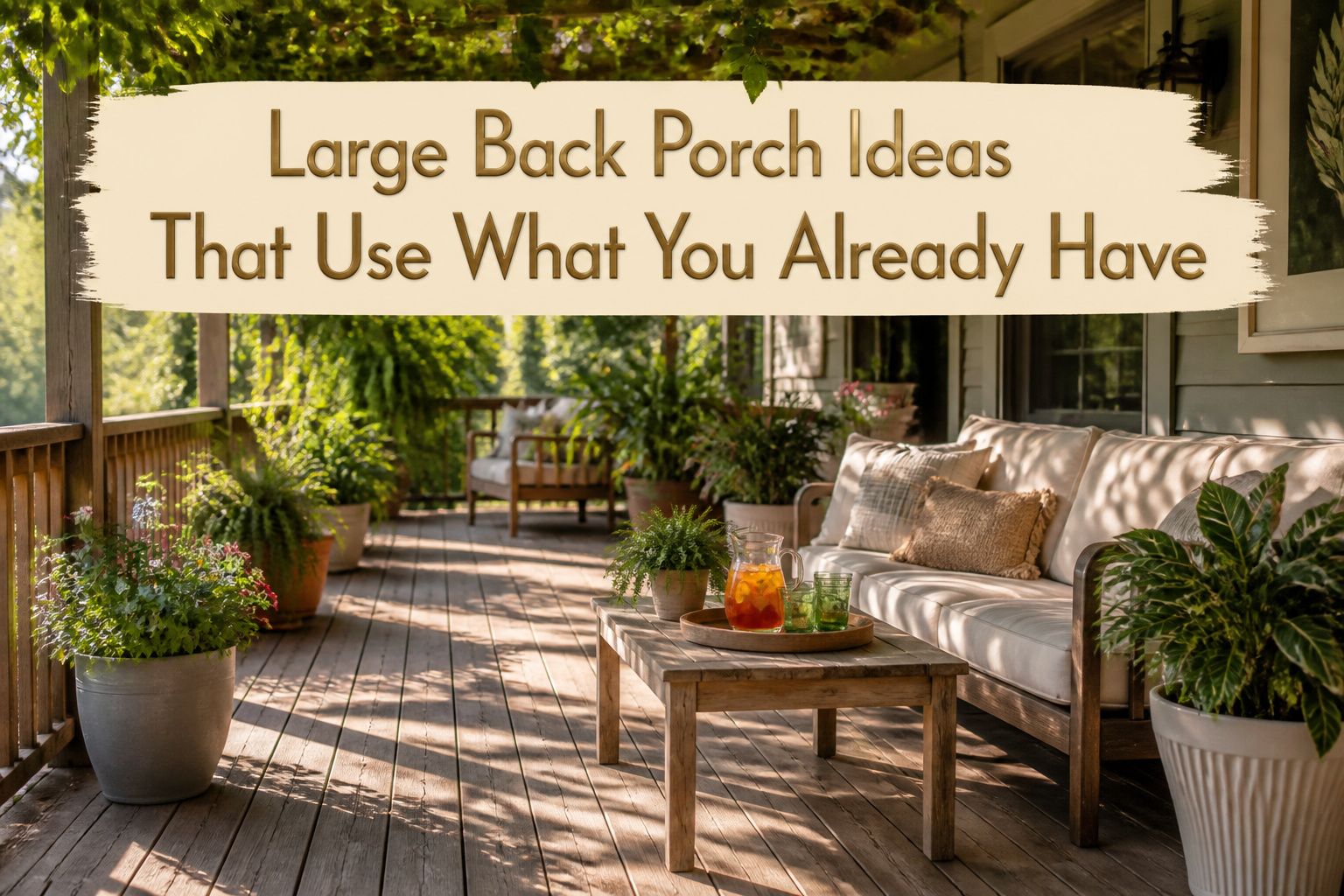
A large back porch can be furnished for under $500 or stretched across weekends of custom carpentry; what decides your path is whether you own the space or answer to a lease. The condition that changes everything is moisture: cushions billed "water-resistant" still mildew in the seams, and indoor furniture left under cover turns musty within two humid weeks. I learned that after watching a roommate’s upholstered armchair absorb a smell that never left, while the $7 plastic planters with self-watering strings survived falls and forgotten waterings alike.
1. Bring It to Life with Plants
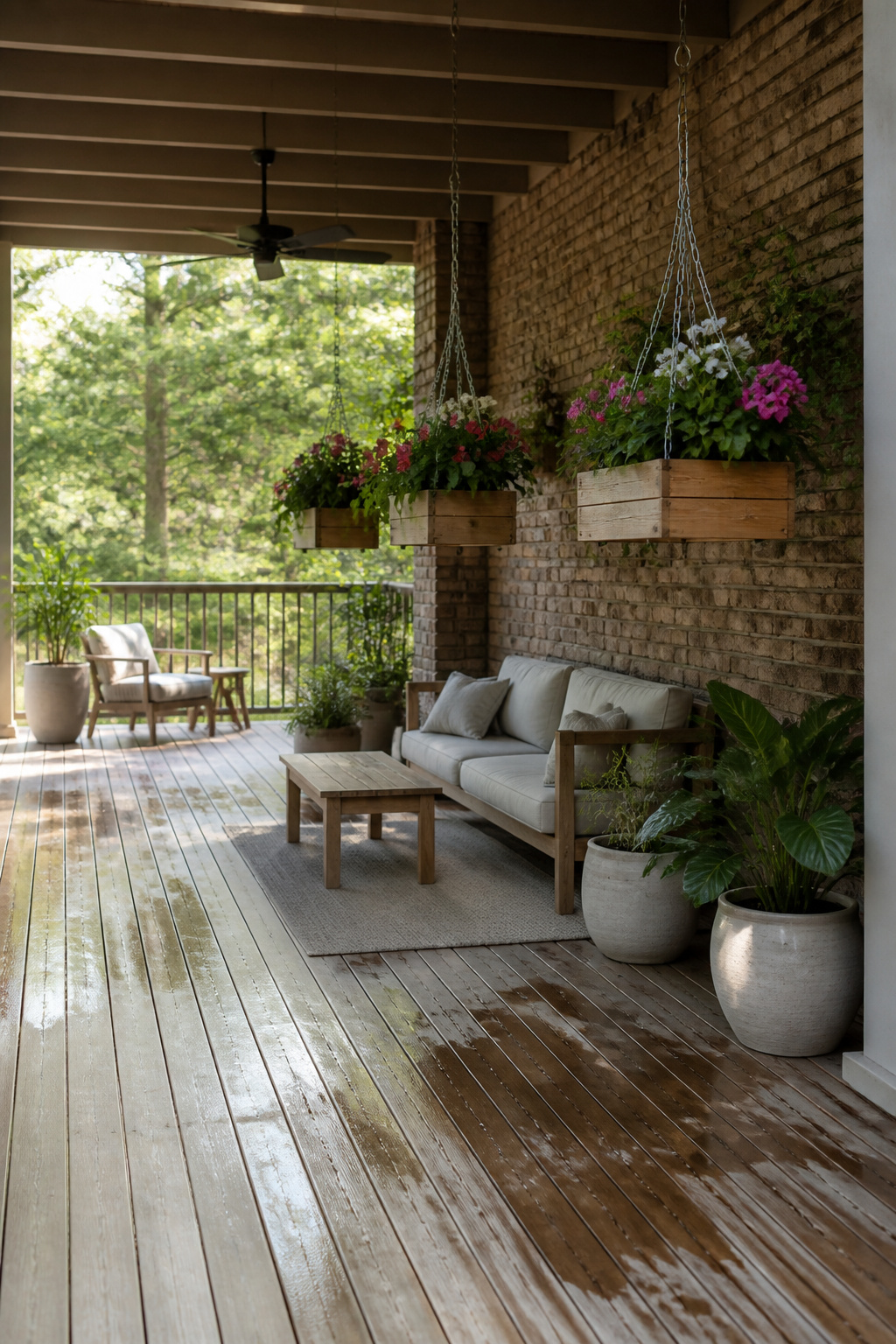
Plants turn a covered porch from a pass-through into a room you want to sit in, but a solid roof changes the math on what actually grows. My own shaded back porch taught me that lesson with a row of dead herbs before I accepted the light I had.
Hanging planters solve the vertical problem without eating floor space. Scrap wood and a few eye screws in the header will hold custom boxes with the pots left loose for easy removal, which matters when you need to water or swap a casualty out. Flat-backed planters against a brick wall work too. Spring-loaded brick clips skip the drill entirely, and plastic runs under $7 each against ceramic at over $30. The self-watering ones with an inner basket and wicking string forgive a missed watering day, though in deep shade that string stays wet longer than you might expect.
For what lives versus what merely survives, Rio dipladenias in those wall planters bloom continuously with enough indirect light. Geraniums hold up well enough to fake it. Where even that fails, faux plants have gotten convincing enough to pass at porch distance, and a shaded porch is honestly the best place to use them. No one checks the soil on a plant hung eight feet up.
The drip tray stays non-negotiable. Water stains on painted porch boards are permanent, and "outdoor" wicker still molds where it sits wet.
2. Add Style and Pattern With an Outdoor Area Rug
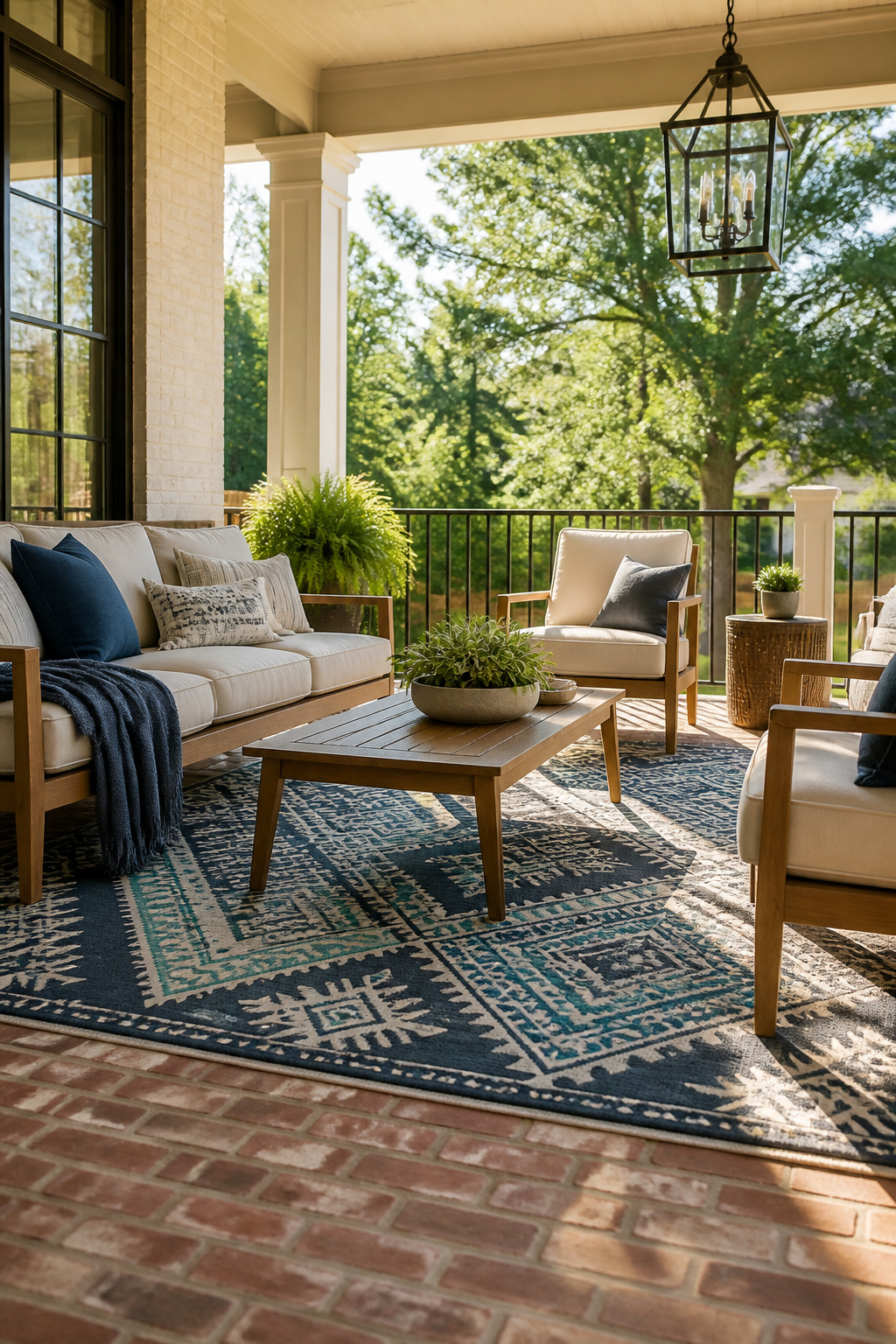
Outdoor rugs run much cheaper than indoor ones, so you can cover a large concrete or brick floor with pattern and color without eating up the whole budget. Three years in, the two rugs on my back porch still look like new, which matters when you are trying to get a weekend project done and not start over next spring.
The trick is buying for the actual weather, not the marketing photo. Polypropylene holds up to rain and sun; natural fibers mildew. I learned that after trying to save twenty dollars on a jute look-alike that went fuzzy and smelled by August. Now I check the label for UV resistance and hose-down construction, and I bring smaller accent pillows inside when severe weather hits. The rug stays put.
Most outdoor rugs come in several colorways beyond the stock photo. Blues and greens read freshest against brick or gray concrete, but a navy geometric or a muted medallion works if your furniture is already loud. Buy the size that lets every chair leg sit on it, not just the front two, or the rug ends up looking like a postage stamp on a runway.
3. Create a Conversation Area
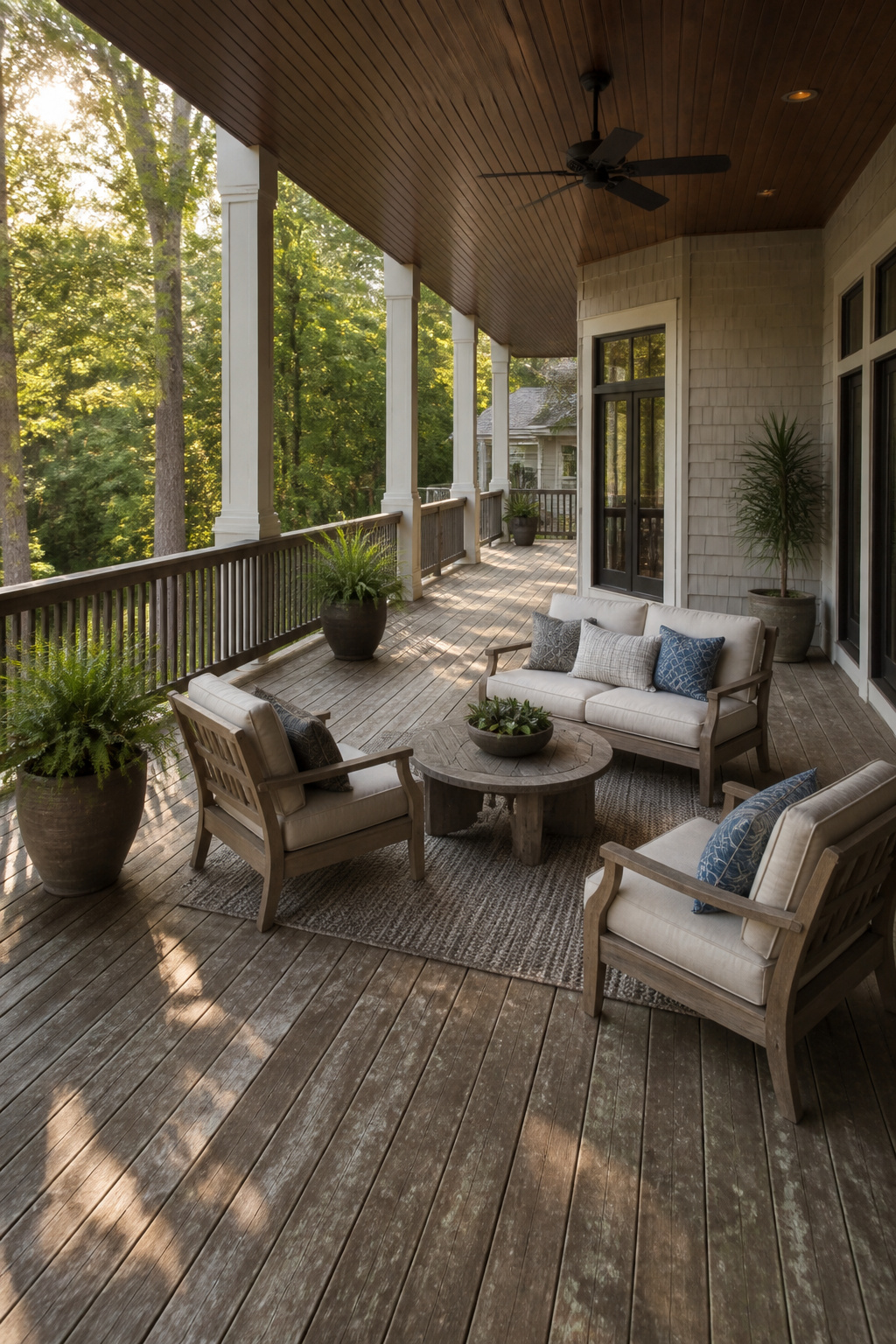
A large porch tempts you to fill every square foot, but conversation areas work better when you leave them half empty. Two chairs, a loveseat, and a coffee table give four people a place to actually face each other. Anything more, and someone ends up shouting across the gap or wedged into a corner they cannot leave without bumping knees.
I looked at four-piece conversation sets because buying the pieces separately pushes past $1,000 fast. The woven sets with acacia or rattan frames run under $500 if you shop the right listings. Thinner cushions come with the tradeoff: less plush, but they dry in hours instead of days and store inside without hogging closet space. Zippered covers matter more than cushion depth, since pollen season turns everything gray in a week.
For a long, narrow porch like mine, two rugs split the rectangle into zones instead of one oversized one that fights the shape. The furniture sits on top, not at the edges, so the brick still shows through as a border. Indoor-outdoor pieces that read as living-room furniture from ten feet away let the porch feel finished without looking like a patio showroom exploded onto it.
4. Give Old Outdoor Furniture a New Look With Patterned Pillows
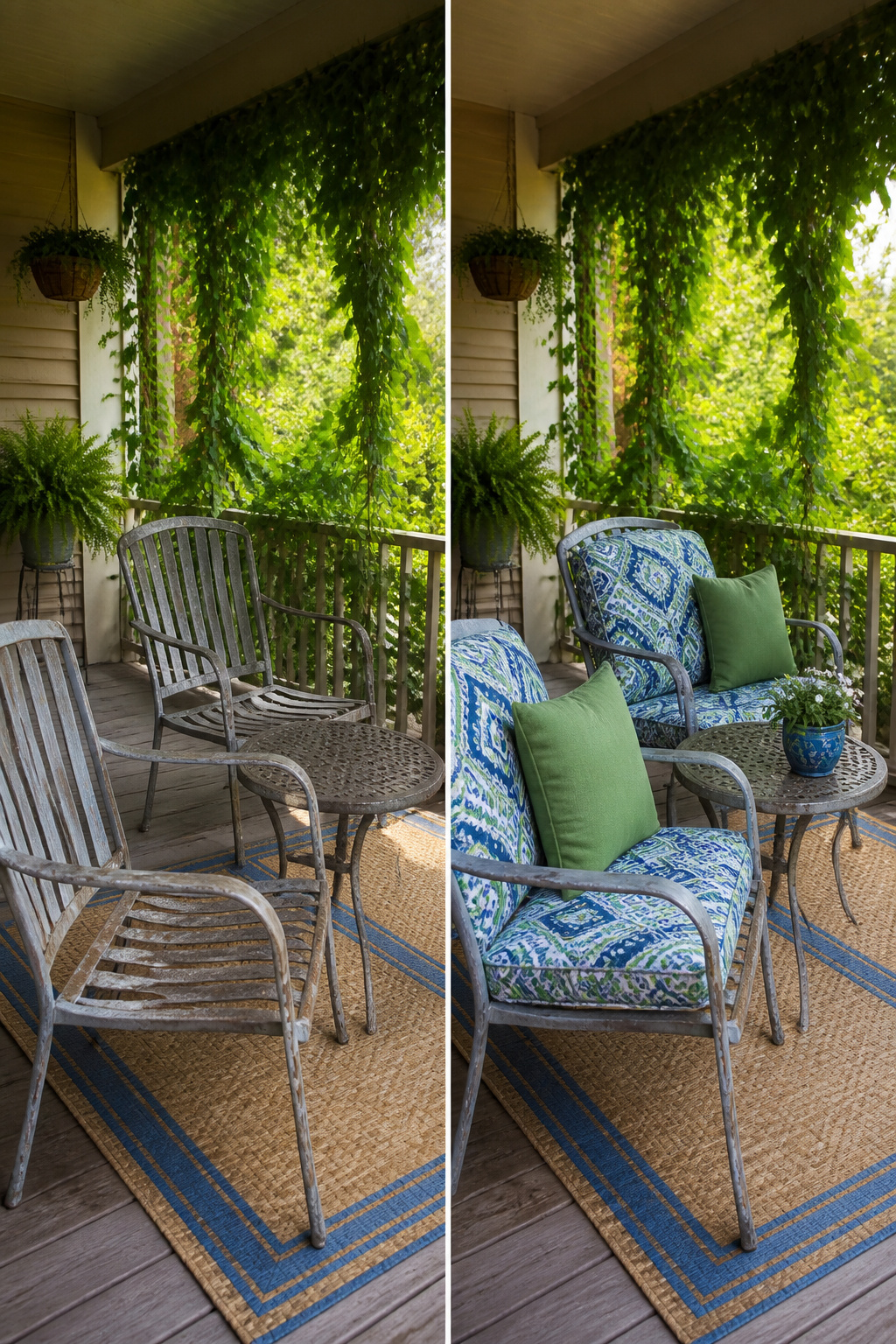
The metal chairs on my porch looked tired long before they were actually worn out. Swapping the seat cushions for new patterned pillows cost about a third of what replacing the set would have, and the visual lift was immediate. I went with 18-inch blue patterned outdoor pillows for the chairs and a pair of navy Sunbrella pillows with green edging for the loveseat.
Textiles outside need to earn their keep. UV-resistant and water-resistant fabrics exist for a reason, and skipping them means storing pillows after every afternoon shower or watching them fade to a washed-out version of themselves by August. The sources I trust bring cushions inside for severe weather and over winter, which tells me even the good stuff has limits.
My own mistake was assuming "outdoor safe" meant "leave out always." A summer of mildew taught me that water resistance buys time, not immunity. Now I check the tag for actual Sunbrella or equivalent solution-dyed acrylic, not just a vague outdoor label, and I still stack them in a deck box when the forecast turns.
5. Bring Shade to Your Space
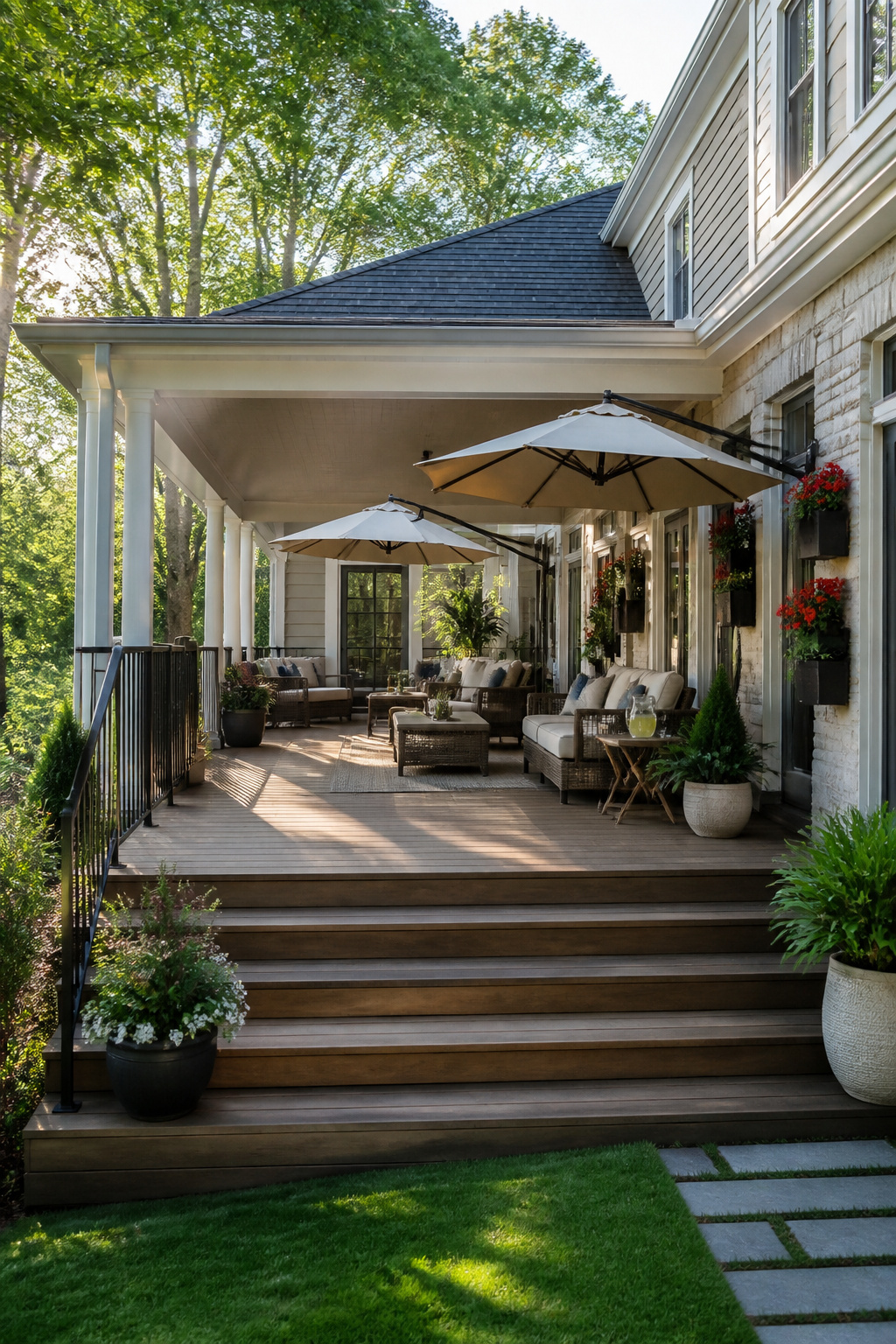
A fully covered porch can stay ten to fifteen degrees cooler than open decking, but it also blocks the light that keeps most flowering plants alive. The workable middle is partial shade you can adjust through the day. Two large patio umbrellas, angled independently, let you shadow the seating area at 3 p.m. without turning the whole space dim. On my neighbor’s open deck, that setup costs under two hundred dollars and moves in ten minutes when the sun shifts.
Brick clips and spring-loaded hangers matter here too. They let you hang a planter or a light fabric panel from the porch header without drilling, which matters on rental property where the lease forbids it. Flat-backed planters hung in a row can break up direct afternoon light into dappled shade; the self-watering kind, with the inner pot and wick string, forgive a missed watering when you are out there under the umbrella instead of tending plants.
Faux geraniums work under solid cover where real ones will not. The convincing ones now cost about what you’d spend replacing dead shade plants twice a summer.
6. Move Indoor Furniture Out
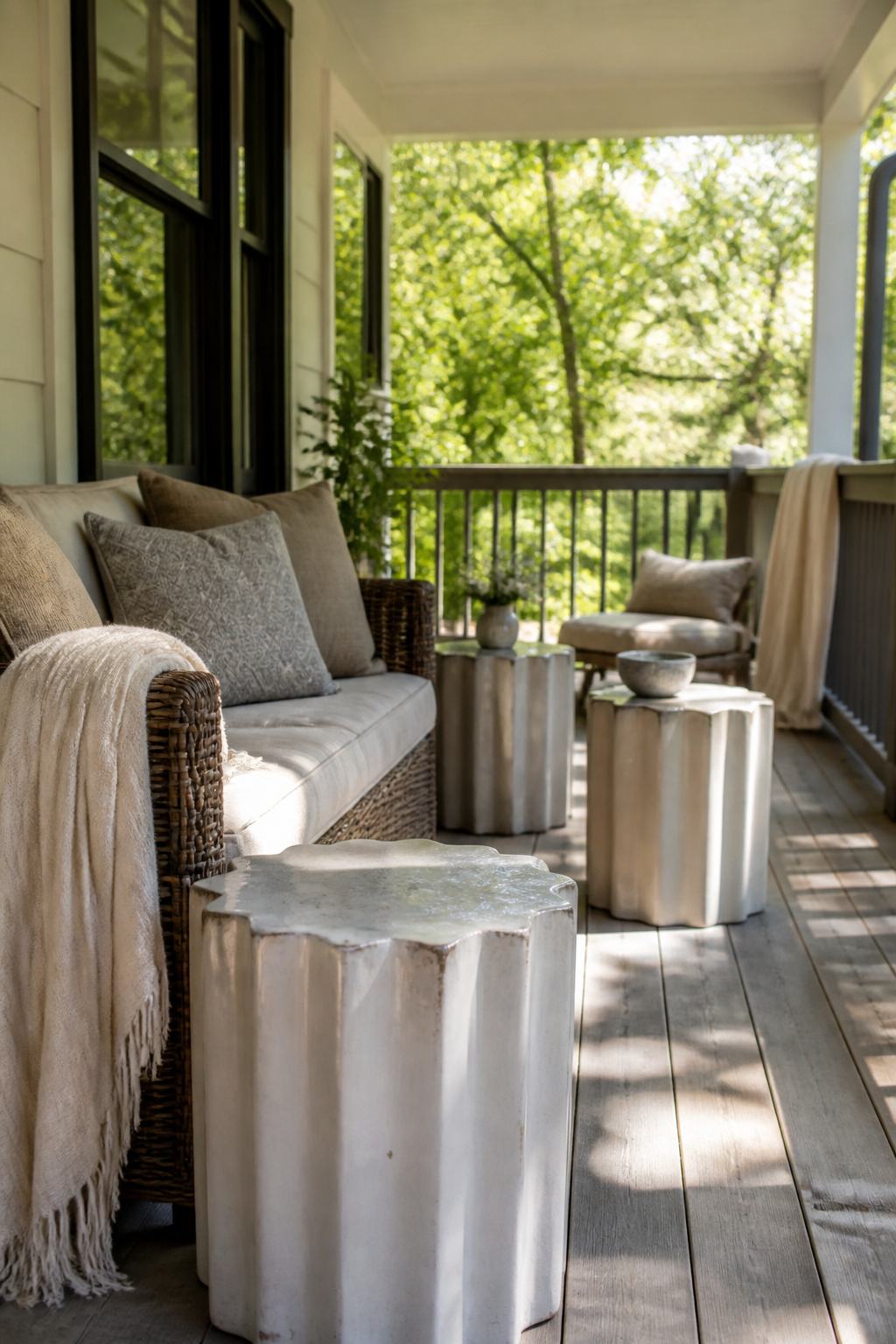
Indoor furniture on a porch lives a harder life than it signed up for, but some pieces handle the betrayal better than others. Ceramic garden stools have become my favorite test case: most of the year they hold bath towels beside the tub or books next to a reading chair, then migrate outside once the weather turns. The wavy-edged concrete ones survive the swap without complaint, and the white cut-out versions do the same. The trick is choosing pieces that do not mind a little identity confusion.
What fails is anything with legs that wick moisture or cushions that never fully dry. I learned this watching a roommate’s upholstered armchair turn musty after two humid weeks under cover; the frame held, but the smell never left. Rockers and dining sets built for porches from the start, or custom-built to actual porch dimensions, outlast these experiments by years. A bed swing built from leftover lumber gets more family use than any repurposed loveseat I have tried.
The indoor-outdoor line is blurrier than retailers pretend. Garden stools work because they are essentially stone with a glaze. Anything softer, anything that absorbs, treats the porch like a vacation it cannot afford.
7. Create Ambience With Outdoor Lighting
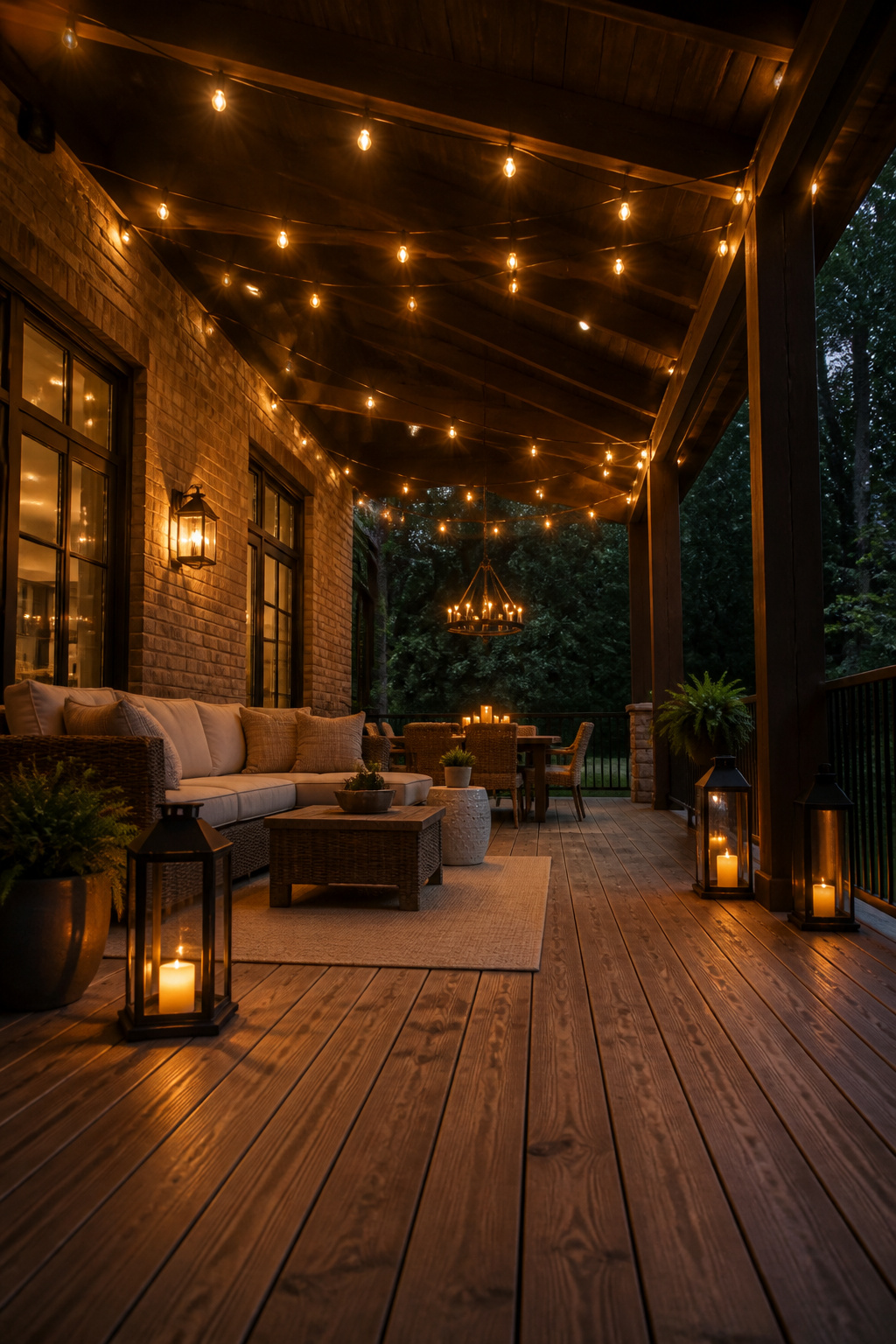
String lights turn a large porch into usable space after dark, and the installation matters more than the bulb style. On a covered porch, the usual mistake is running them too tight; a little sag between anchor points softens the light and hides a wobbly hand with a drill. Solar-powered strings exist now, which removes the extension-cord problem entirely if your roofline gets afternoon sun.
Ceiling areas call for something different. An outdoor chandelier gives actual task light for a dining table and draws the eye upward in a tall space. The fixtures run under $100 for clean-lined lanterns in matte black, and swapping one in for a corroded builder-grade light takes about twenty minutes if the junction box is already there. The chandelier wins for dinner parties; string lights win for everything else. On my own porch, candlelight still beats both on summer nights, though I use it less than I mean to.
8. Decorating for a Focal Point
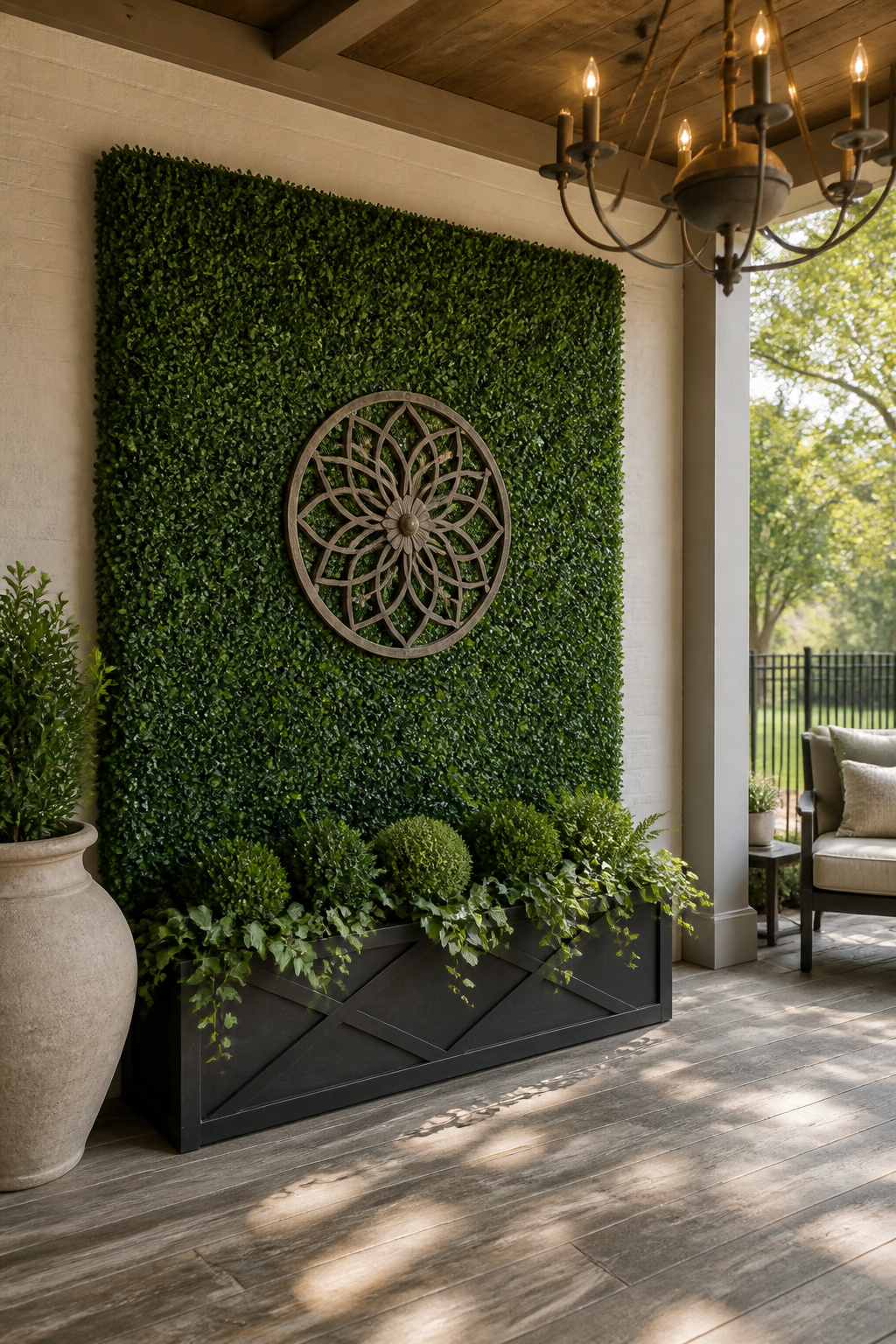
A wall that sits too blank on a large porch reads like an afterthought. Faux boxwood panels can turn that dead space into a living wall effect that reads intentional from twenty feet away. The panels interlock like tile, and once they cover the full surface, the texture does the heavy lifting. A simple sign layered in front keeps the look from going flat.
Ceilings on an open porch work the same way. Swapping a builder-grade fixture for an outdoor chandelier with candelabra bulbs draws the eye up and gives the whole span a center of gravity. The original ceiling may only need patching and paint, or thin plywood strips spaced with a nickel gap can replace damaged beadboard without the cost of the real thing. Either route, the ceiling becomes the thing people mention first.
9. Porch Floors
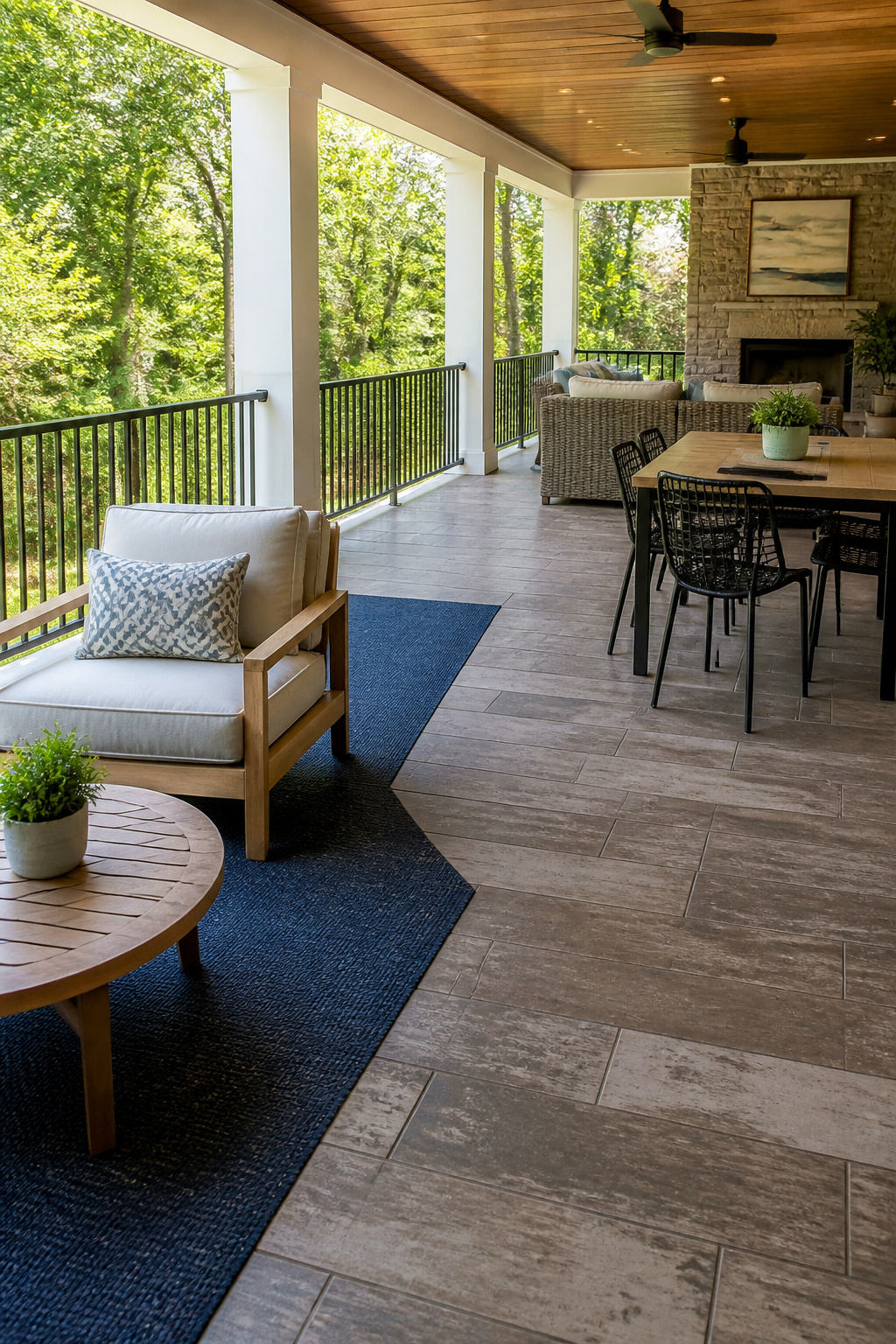
Wood floors on a porch that started life as an interior space tend to rot where previous owners removed walls and let weather in. The proper fix is tearing out the damaged boards and laying outdoor-rated flooring, which works fine for a wide-open back porch. A mostly enclosed front porch used like indoor space in summer is a different problem; gaps between boards let drafts through, and paint over patch jobs chips fast. On one front porch, the owner rebuilt framing under a large rotted section, painted it, and watched the paint fail within a season. The last attempt to save that floor was carpet tiles rated for outdoor use, which brought softness and coziness without the gaps. For concrete, skip paint and use a concrete refinishing product instead; it held up on exterior steps where paint would have peeled.
10. Large Porch Lighting Ideas
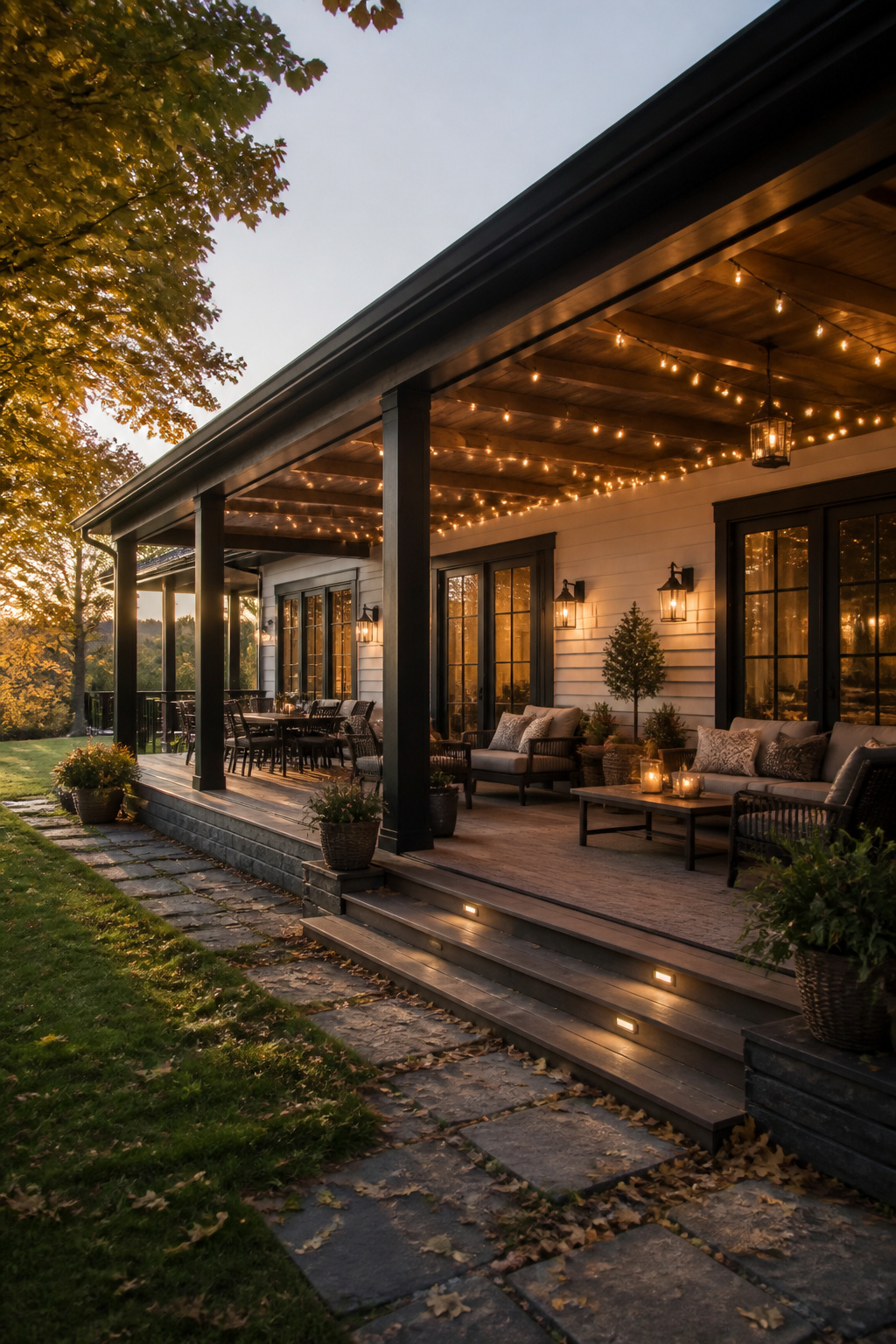
Scale changes everything about lighting. On a small stoop, one fixture does the work; on a large porch, a single source leaves whole corners in shadow and kills whatever conversation area you set up there. String lights carry most of the load, and for good reason: at under $100 for a decent set, they cover spans that would need three or four hardwired fixtures. Rounded globes give the softest spread, and solar-powered versions now exist if you do not want to run an extension cord across your space.
Wall sconces still matter, but swap them for clean-lined lanterns in matte black rather than leaving the corroded originals that came with the house. One fixture under $100 anchors the door; beyond that, rope light tucked into J-channel along siding edges fills the gap between accent and path lighting without adding another junction box. Candlelight works in summer, though that is mood, not visibility, and mood does not keep someone from tripping on a step they did not see.
11. Porch Decorations: Furniture
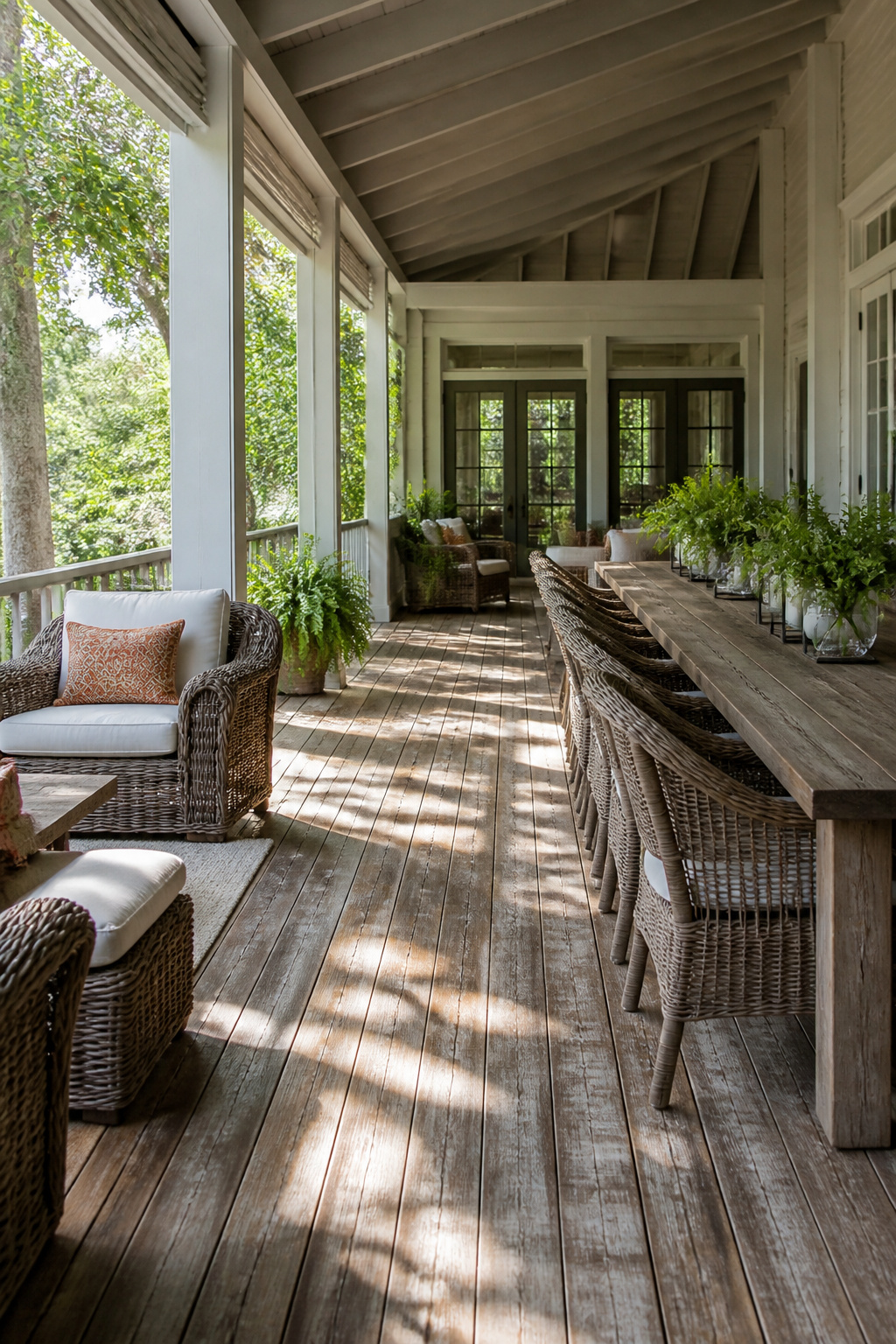
Scale is the first problem a large back porch throws at you. A loveseat that anchors a small patio will look like a dollhouse piece against twelve feet of blank wall, so the depth of the seat matters more than the footprint. I look for outdoor chairs with a seat depth of at least 22 inches. Anything shallower reads as staging furniture, not a place to settle in.
The sources I trust on this split the room the same way they would indoors: one corner for eating, one for sitting, and a third left deliberately empty. A custom-built table can bridge two zones without cluttering either. I have not built one myself, but the idea of sizing a table to the exact depth of the porch rather than buying off-the-rack appeals to me because it solves the dead-end problem that plagues long, rectangular spaces.
Storage pieces work harder on a porch than almost anything else. A bench with a hinged seat, placed where the porch narrows, fills the gap without breaking the sightline. I would rather have one piece that holds cushions and gardening tools than a row of small items that each need their own footprint.
For budget, the four-piece conversation sets that come in under $500 are where I would start. The frames are usually acacia or woven resin, and the cushions are thinner than indoor foam. That is a trade I accept. Thin cushions dry faster, store easier, and let you bring them in when pollen season hits.
12. Decorate Your Porch Using Textiles
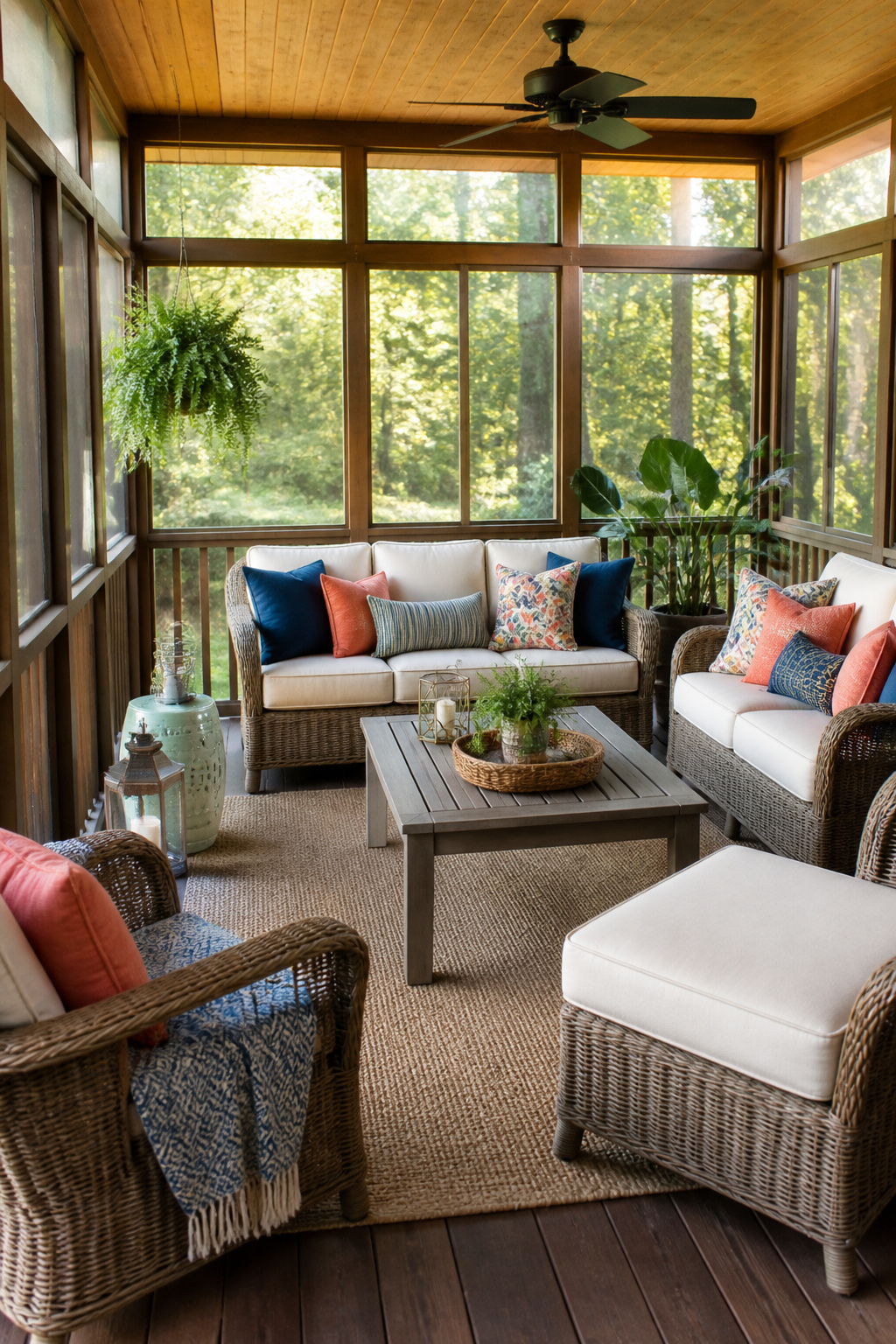
Sunbrella fabric changed how I think about porch textiles. Three years on an exposed back porch, and cushions in that material still hold their color where cheaper ones went chalky by August. The difference is UV resistance built into the fiber itself, not a surface coating that flakes away.
For a large porch, a 18-inch pillow covers enough visual ground to read from across the space. Two of those on a loveseat, maybe a throw in a heavier weave for the hour when the sun drops and the temperature follows, and the seating starts to feel finished rather than leftover. Water-resistant backing on a throw matters more than the pattern; the morning after a storm, you want to shake it off, not haul it to a dryer.
Outdoor rugs run cheaper than indoor ones, which is useful on a big footprint where a living-room-sized weave would cost double. The trade is that they sit lower to the ground and move more, so furniture weight or a pad underneath keeps them honest. Brick floors especially want that color break; without it, the eye reads the whole porch as one continuous surface and the furniture floats.
13. Plant Decorations
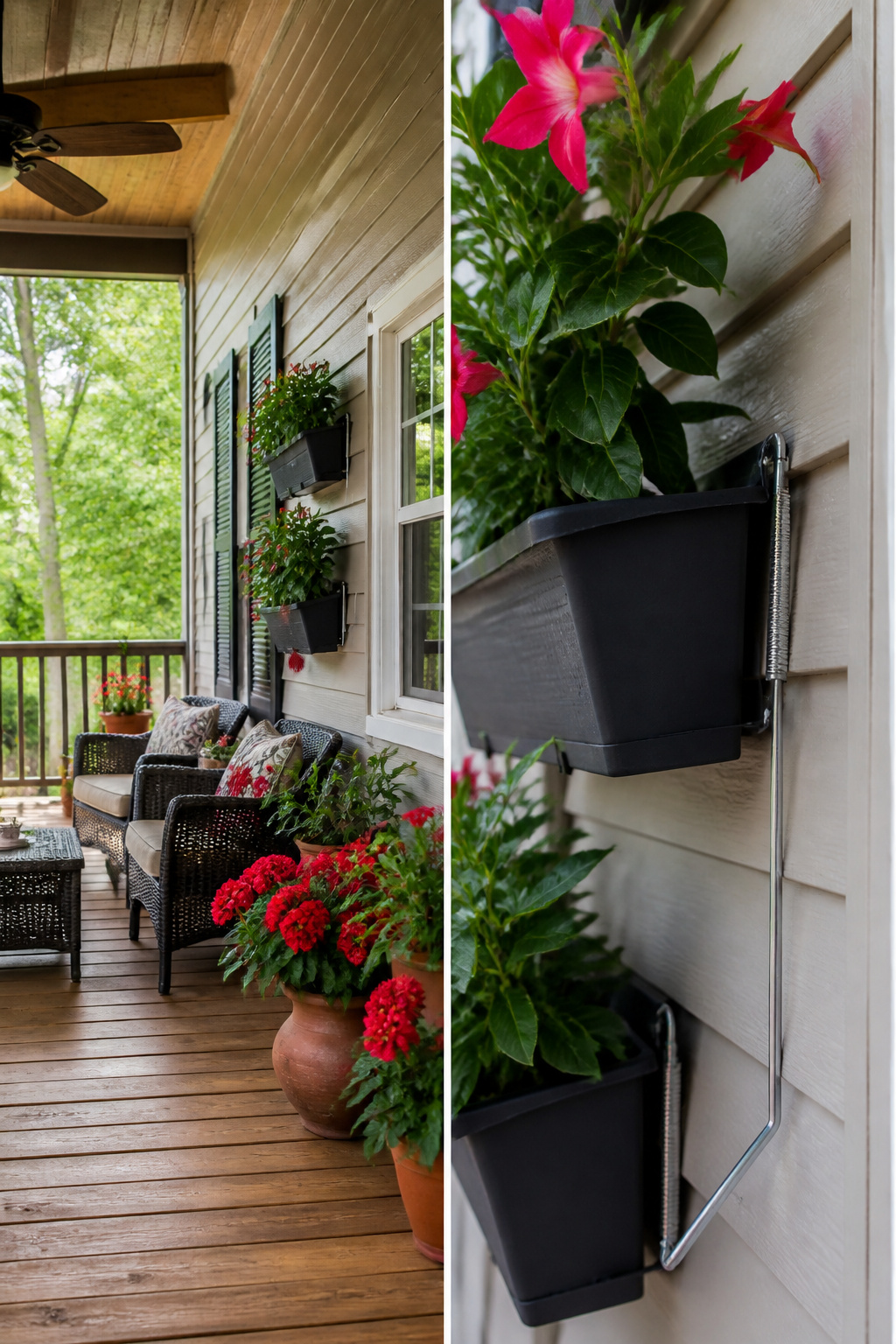
A covered porch can starve plants of sun, which is why hanging arrangements work better than floor pots in some spots. Under $7 plastic planters with a self-watering string beat the ceramic ones I liked at $30 each, and plastic survives a fall if a clip slips. Flat-backed styles screw to wood or clip to brick with spring-loaded hangers if you want to avoid drilling masonry.
The inner pot wicks extra water back up through a string, so dipladenias or herbs tolerate a missed watering. I split a few large rios across six baskets for a wall of green that reads as decoration, not just gardening.
Faux geraniums have gotten convincing enough to fill a fully shaded header where nothing alive would grow. Custom scrap-wood frames let you pop pots out for rotation, or swap in silk for winter without the porch looking abandoned.
The Bed Swing I Almost Built
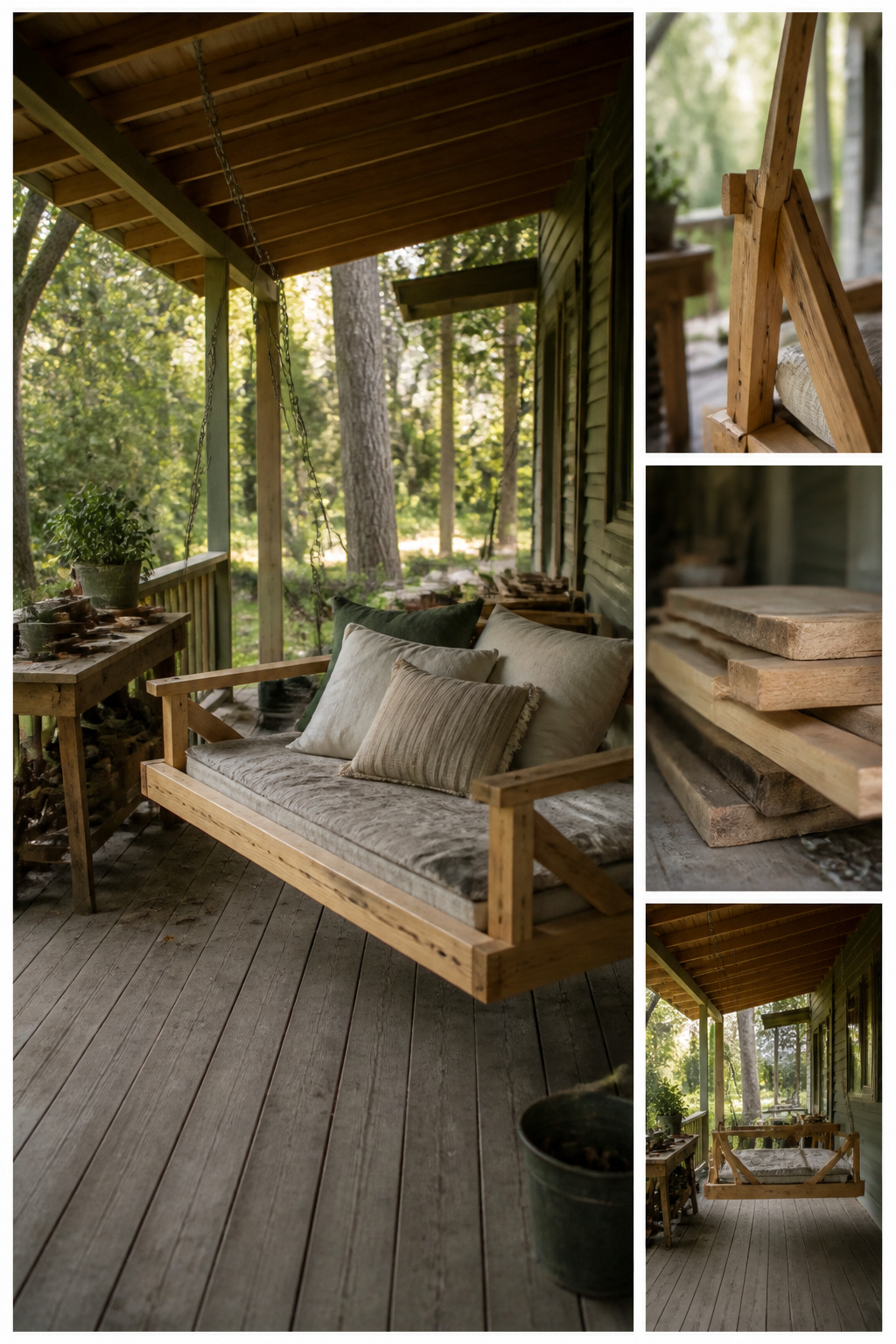
A bed swing built from leftover lumber is the kind of project that sounds perfect on paper until you count the boards. I mapped it out one Saturday after seeing one in use: two people, a twin mattress, slow afternoon. The appeal is the coziness, the way textiles turn it into something closer to a room than a porch.
The lumber math killed it for me. Leftover stock from earlier builds adds up fast in theory, but bed swings need real depth and serious reinforcement. A twin mattress runs roughly 75 by 38 inches, and the frame has to overhang that, carry the weight, and survive swaying. My pile of offcuts would not produce enough continuous, straight grain for the long rails without a patchwork look and weak joints. Buying new lumber to fill the gaps defeated the whole premise.
So the bed swing stayed on the list as a someday project, and I moved on to smaller wins. If your scrap pile is deeper than mine, or you have old framing lumber from a real demolition, the build itself is straightforward joinery. The textiles part is simpler: layered pillows, a rug underneath, and a plan to haul cushions inside before storms or winter. UV-resistant outdoor fabrics exist, but even they last longer with that habit.
What I Spend on a Porch Refresh
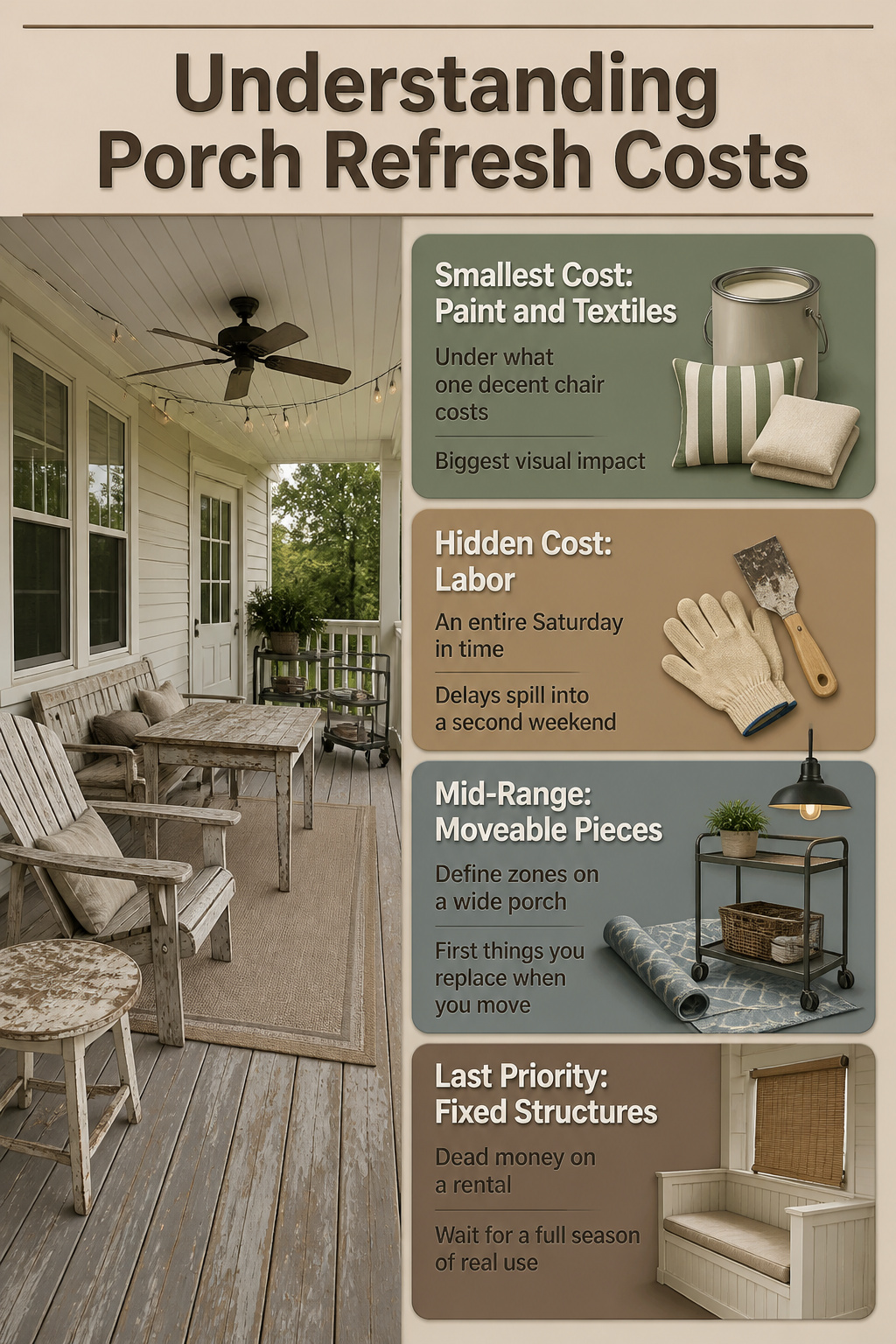
A large back porch refresh breaks into three buckets, and the split matters more than the total. Paint and textiles eat the smallest slice but change the most surface area. That is where I start when the budget is tight. A gallon of exterior paint and a few pillow covers run under what one decent chair costs, and they cover the sins of old furniture.
Labor is the hidden line item, even when the labor is yours. Stripping and repainting a salvaged table costs almost nothing in materials and an entire Saturday in time. I have learned to count that Saturday as a real expense. If the forecast turns or a coat fails, the project bleeds into a second weekend fast.
The middle money goes to pieces that move. A rug, a rolling cart, a light fixture you wire yourself. These are the items that define zones on a wide porch, and they are also the first things you replace when you move.
What I skip until last is fixed structure. Built-in benches, mounted shades, anything that leaves holes or stays behind. On a rental, that spending is dead money. On a first home, it still waits until I know how we actually use the space through a full season.
What Lasts and What Does Not
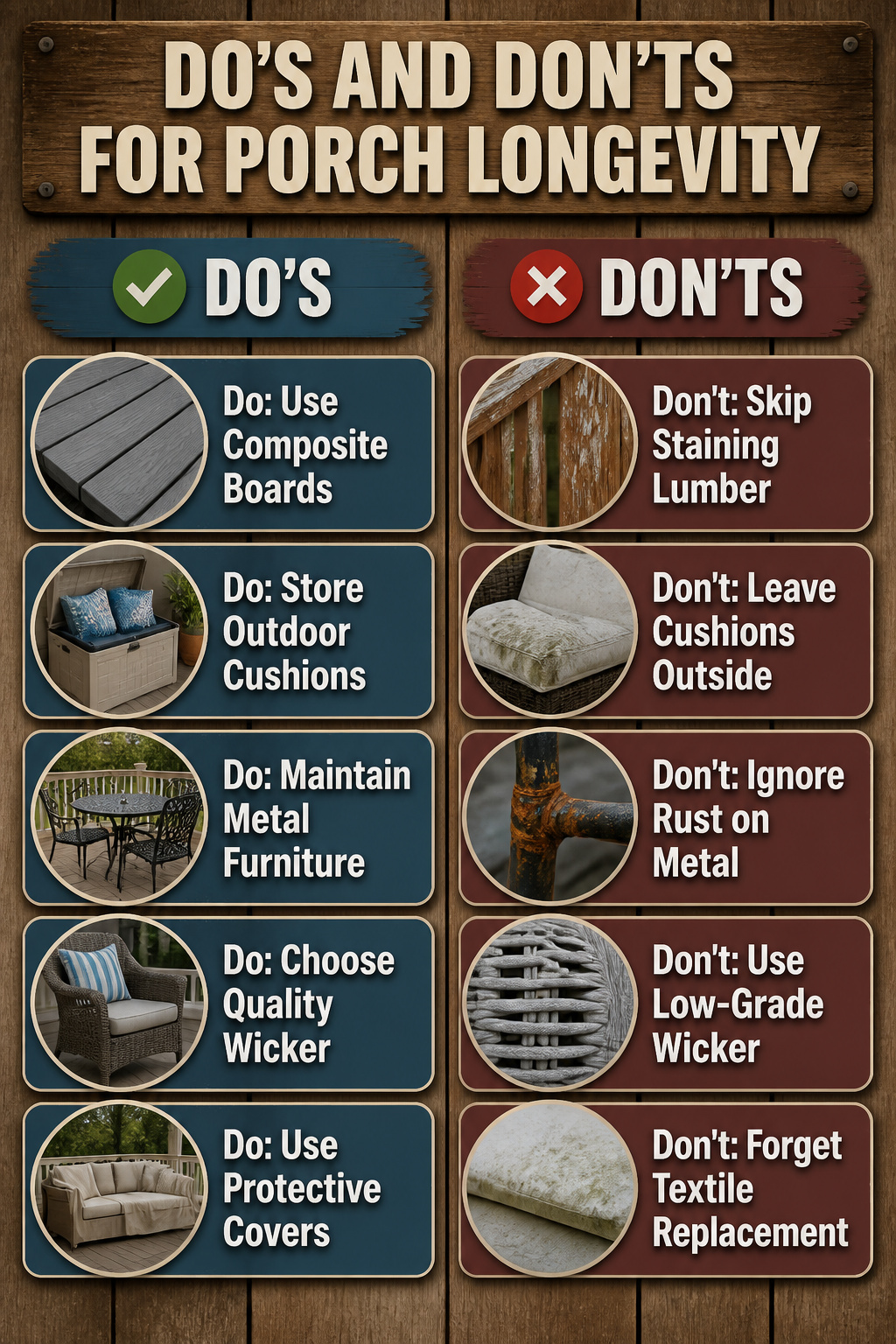
What lasts on a large back porch and what quietly rots is rarely obvious at checkout. Pressure-treated lumber looks sturdy until the annual re-staining becomes a three-weekend job; the finish peels where rain pools on horizontal rails, and the gray sets in faster than the label promised. Composite boards cost more upfront but drop to nearly zero maintenance, which matters when your porch is deep enough to seat eight and the square footage adds up fast. Outdoor cushions billed as "water-resistant" still need storage or they mildew in the seams; the ones that actually survive a season of real weather run heavier and cost about double. Metal furniture holds up unless the powder coat gets nicked, then rust blooms from the inside out. Wicker is the same story in reverse: synthetic versions fade to chalk, natural versions invite carpenter bees. Plan on replacing textiles every two to four years in humid climates, five to seven if you are diligent about covers. The real budget hit is not the first purchase; it is forgetting that everything out there is on a timer.
How I Arrange a Large Space Without a Plan
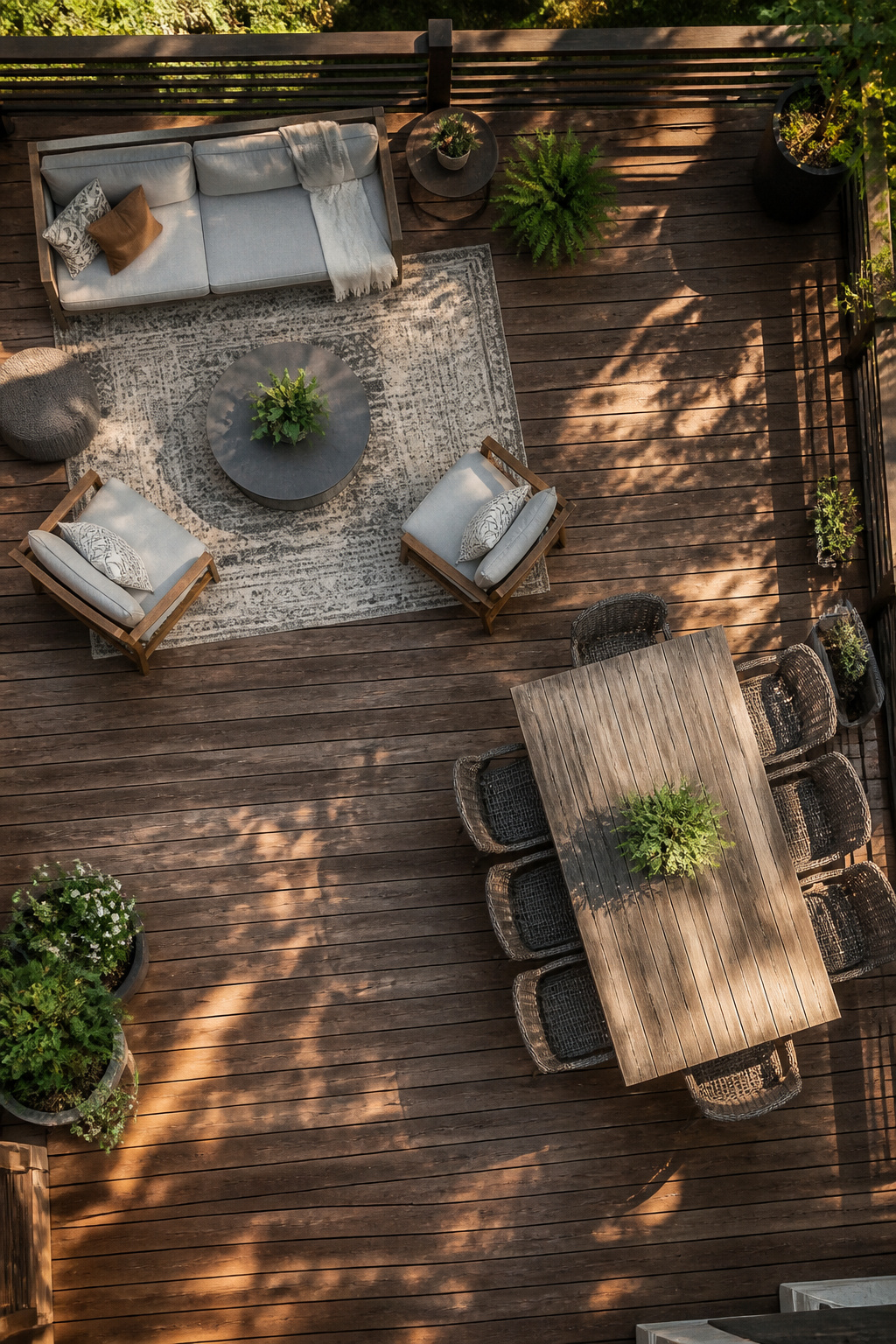
A large porch tempts you to push everything to the walls and leave the middle bare, which turns it into a hallway you walk through instead of a room you stay in. Three zones is the most a weekend budget can hold before you spread yourself thin, so I start by deciding what actually happens out there. One spot for sitting, one for eating, one for whatever the house lacks, maybe a place to pot plants or let the dog dry off.
The first time I laid out ours, I gave the seating group too much breathing room. Six feet between the sofa and the chairs looked generous on paper, but conversations felt like shouting across a parking lot. Four feet works better for talking; six is where you need an excuse to cross it. Measurements vary too much from house to house, so I pace it out in my own strides and live with the tape lines for an evening before I commit.
Traffic paths need their own space or people cut straight through your conversation. I leave about three feet along the railings for passing through, then let the furniture claim what is left. If a chair blocks the natural line from the door to the grill, the layout fights you every time you carry out the burgers.
Frequently Asked Questions
What are some budget-friendly back porch ideas?
Start with paint and textiles, since a gallon of exterior paint and a few pillow covers cost less than one decent chair while covering the most surface area. Hanging planters built from scrap wood and eye screws add vertical greenery without eating floor space, and outdoor rugs run much cheaper than indoor ones while covering large concrete or brick floors with pattern and color. String lights under $100 carry most of the lighting load across spans that would need multiple hardwired fixtures.
How can I decorate my large porch?
Split the space into three zones at most, one for sitting, one for eating, and one for whatever your house lacks, leaving traffic paths clear along railings. Use focal points like faux boxwood panels or an outdoor chandelier to give blank walls and tall ceilings a center of gravity. Indoor-outdoor furniture that reads as living-room pieces from ten feet away keeps the porch from looking like a patio showroom.
What type of lighting is best for a porch?
String lights with rounded globes give the softest spread and cover large spans for under $100, while solar-powered versions remove the extension-cord problem if your roofline gets afternoon sun. An outdoor chandelier in matte black under $100 anchors a dining table with actual task light and draws the eye upward in tall spaces. Candlelight still wins for mood on summer nights, though it provides visibility, not just ambiance.


