
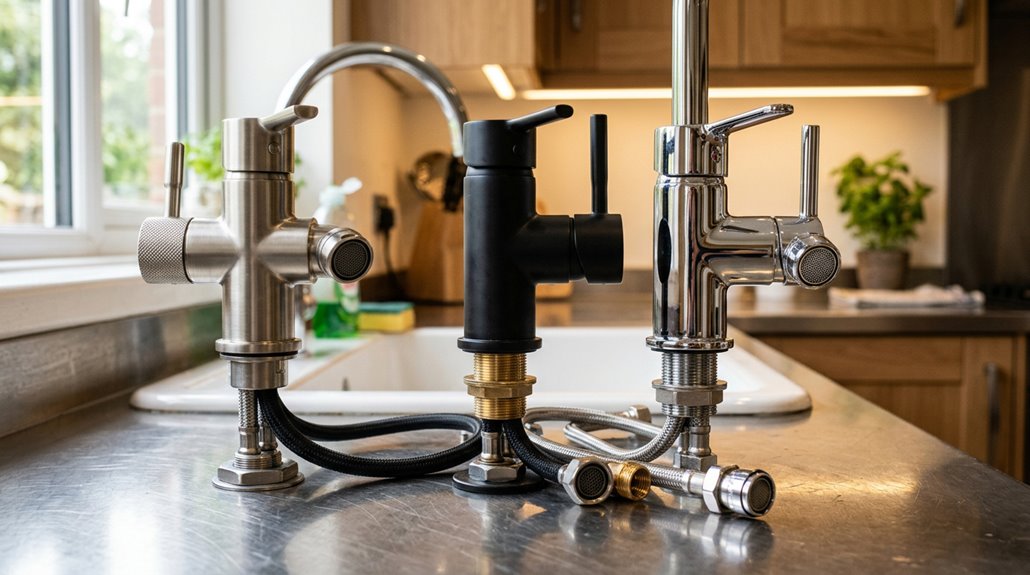
Kitchen faucets aren’t universal; the sink’s hole configuration (1, 3, or 4 holes) determines compatibility, not the faucet’s label. Center-to-center spacing is also important, especially on older sinks with non-standard measurements.
Thread sizes vary (3/4″, 55/64″, etc.), and under-sink water line sizes must match. Escutcheons can cover mismatches, but they are temporary fixes, not true solutions. You will need specific measurements before shopping: hole count, spacing, and water line sizes. If you get this wrong, you may end up buying adapters or drilling new holes. Paying attention to the details is essential.
Kitchen Faucets Aren’t Universal: Here’s Why
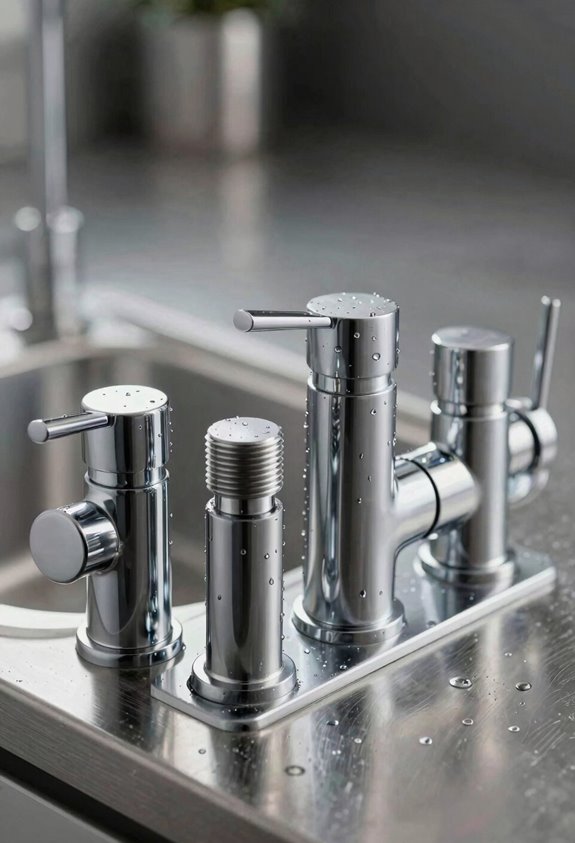
Why did I learn this the hard way? I assumed my new faucet would fit my sink like any other. I was wrong. Kitchen faucets aren’t universal; they are specifically designed for your sink’s hole configuration and center-to-center spacing.
Kitchen faucets aren’t universal—they’re specifically designed for your sink’s hole configuration and center-to-center spacing.
What I discovered is that your sink determines everything. Is it 1-hole, 3-hole, or 4-hole? That information matters. My 3-hole sink required exact spacing between hot, cold, and spout connections. I chose a faucet without checking, and it wouldn’t align properly.
Thread sizes complicate matters further. Female fittings come in 3/4″ or 55/64″, with small differences that can prevent connections. Male threads vary too, such as 13/16″ versus 15/16″.
Compatibility isn’t guaranteed just because both are labeled as kitchen faucets. You need matching hole configurations, proper center-to-center measurements, and compatible threading. Skipping this research means you might end up buying adapters or hole plugs you didn’t expect.
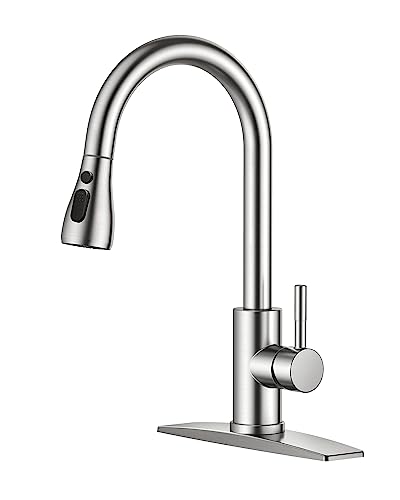
CERTIFIED BUILD FOR CONFIDENCE — Certified to cUPC & NSF/ANSI/CAN 61 standards and built to meet lead-free requirements, this kitchen faucet uses SUS304 stainless steel, heat-resistant PEX lines, and a drip-free ceramic cartridge for steady operation

Elegant Brushed Nickel Finish & Modern Design-Featuring a premium brushed nickel finish, this kitchen faucet offers a sleek, modern look that complements any kitchen decor while effectively resisting fingerprints, water spots, and corrosion. The durable stainless steel construction ensures long-lasting performance and maintains a clean, new appearance with minimal maintenance.

GUARANTEED QUALITY: Quality is our top priority, so all our bar sink faucets are tested and certified, meeting or exceeding industry codes and standards
Hole Configuration Is Your Real Constraint
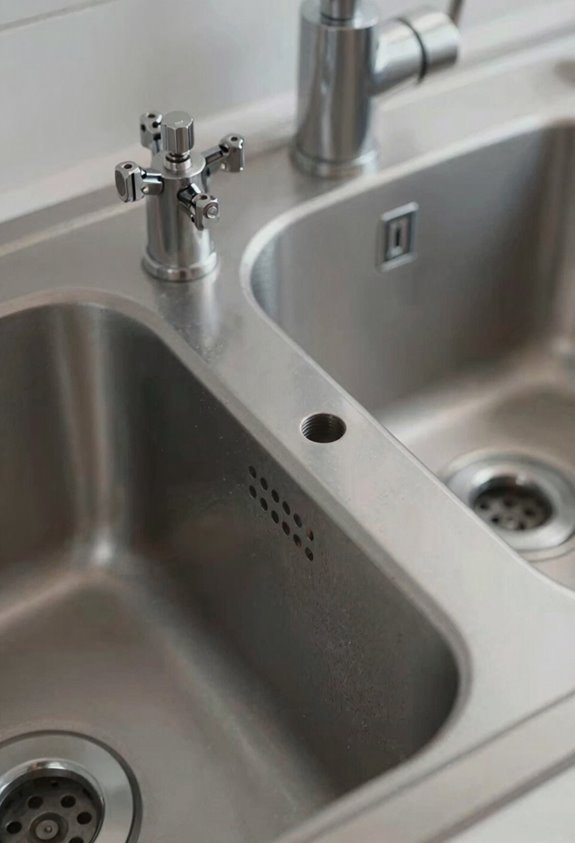
When I finally got serious about understanding faucet compatibility, I realized hole configuration is the real boss. It controls everything else. Your sink’s mounting holes determine which faucets will actually work.
| Configuration | Handle Type | Hole Count | Best For |
|---|---|---|---|
| 1-hole | Single lever | 1 | Modern minimalist |
| 3-hole | Separate controls | 3 | Traditional setups |
| 4-hole | Plus sprayer | 4 | Full accessory options |
I learned this the hard way when I assumed any faucet would fit any sink. Center-to-center spacing is crucial, especially on older sinks with non-standard measurements. You can’t just force incompatible hardware together.
Escutcheons save you. These decorative plates cover extra holes, providing flexibility. If you’re planning to change countertops, consider reconfiguring holes now. It’s more economical to prevent problems than to fix them later.

KITCHEN FAUCET WITH PULL DOWN SPRAYER – Features a toggle button to select spray or stream modes conveniently in the palm of your hand; includes coordinating soap dispenser

Lead-Free SUS304 Stainless Steel Kitchen Faucet: Built with a SUS304 stainless steel spout and finished in brushed nickel, this kitchen sink faucet resists rust, corrosion, and fingerprints. With a maximum water flow rate of 1.8 GPM, it provides steady water output for everyday kitchen cleaning while maintaining a clean, modern look

【DUAL-HANDLE KITCHEN FAUCET WITH PREMIUM VALVE】 4 hole kitchen faucet equipped with a pair of metal lever handles for fine-tuning water temperature, this 3 hole kitchen faucet with sprayer features a high-quality ceramic cartridge that has undergone 500,000 cycles of testing, ensuring reliable leak-free operation for years to come
Escutcheons: How They Solve Spacing Mismatches
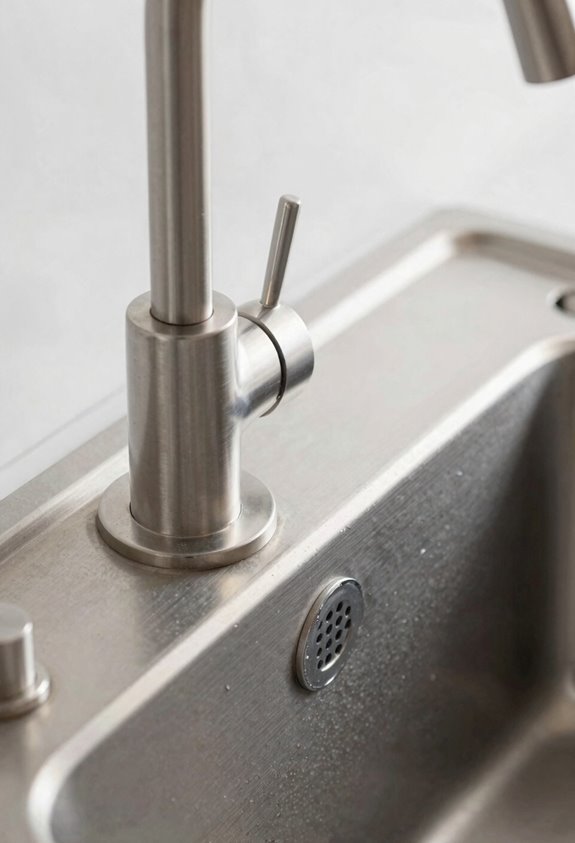
I discovered that escutcheons are essentially the Swiss Army knife of faucet installation; they make hole configuration flexible instead of a deal-breaker. When your faucet’s base doesn’t match your sink’s existing holes, an escutcheon steps in to prevent costly redrilling.
Many people panic over spacing mismatches, believing they are out of options. This is not the case. These decorative plates conceal unused holes, allowing you to install a single-hole faucet on a three-hole sink without complications. They accommodate variations in center-to-center spacing and create a clean, intentional look.
The right escutcheon is not just functional; it also influences your final aesthetic and mounting compatibility. Choosing wisely resolves your spacing problem completely.

Finish: Brushed Satin Nickel

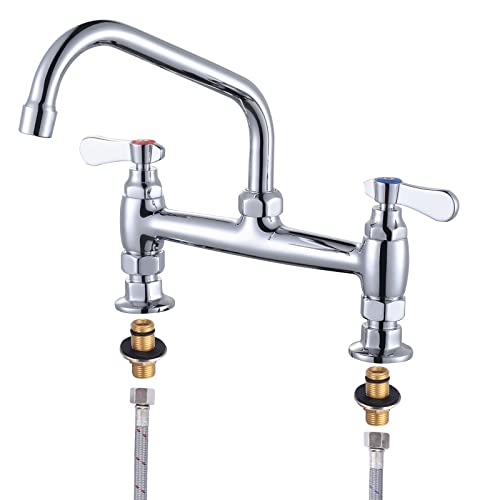
8 Inch Kitchen Faucet: Designed for 2 or 3 hole sinks with an 8-inch centers , this Lead-Free 2 handle kitchen faucet provides a 1.8 GPM flow rate for everyday kitchen tasks
⚠ CONTACT US - We provide professional after-sales support. If you have any questions about the product, please feel free to contact our customer service team at any time. You can contact us through the following methods: the "Ask a Question" function on the seller's homepage, the "Contact Seller" function on the order page, email: [email protected] Contact us at 6263663860 and we will promptly provide you with answers.
Under-Sink Connections: Where True Compatibility Lives
I’ve learned the hard way that under-sink compatibility is crucial; it’s where universal faucets hit their real limits. You’ll find that water line sizes, typically 3/8 inch, and shut-off valve dimensions, 3/8 versus 1/2 inch, either align perfectly with your faucet’s flexible supply lines or they don’t. There’s no workaround for mismatches without adapters. Nail down these specs before you buy, as swapping out valves or hunting for adapters at 10 p.m. is an unnecessary hassle.

Faucet Accessories - 3/4 in. x 55/64 in. - 27 in. adapter

【Standard Female Thread】Our 2.2 GPM faucet aerator replacement fit universal female threaded faucets which sizes: female 55/64 inch,please measure the faucet size precisely prior to purchase.These replacement parts are ideal for bathroom faucets, kitchen taps, and garden spigots.

Universal Compatibility: Designed to fit most kitchen and bathroom sinks, our faucet aerator features male and female thread sizes (24mm and 22mm) for hassle-free installation.
Water Line Compatibility Standards
Where does true kitchen faucet compatibility actually reside? Right under your sink. Your faucet supply lines must match your shut-off valves; there are no exceptions. Most modern setups use 3/8 inch compression fittings, which is the standard. However, some older homes have 1/2 inch valves. Many people spend hours troubleshooting leaks caused by this mismatch. The spacing between your valve connections is also important. Before purchasing a new faucet, measure your existing setup. Check your valve size and verify your hose alignment. These details are crucial. Get them right, and you’ll achieve a compatible installation.
Shut-Off Valve Sizing Matters
The moment you measure your supply lines, you are measuring your shut-off valves, which determines whether they are compatible. Most newer faucets use 3/8 inch compression fittings, but many setups still use 1/2 inch. Your shut-off valve sizing must match both your faucet’s incoming line and your under-sink plumbing. When they don’t align, such as a 1/2 inch valve feeding a 3/8 inch faucet, you will need adapters. This can be frustrating. Therefore, I always verify thread types and outlet sizes before purchasing. Flexible supply lines can simplify compatibility, but only when everything is compatible from the start. Check twice, adapt once.
Design and Spout Variations That Affect Your Choice
How much thought have you really given to your faucet’s spout? I didn’t consider it until I learned that spout variations and threading compatibility significantly impact your kitchen setup.
Here’s what I discovered:
- Spout reach varies dramatically; some extend toward side sink holes, while others remain compact.
- Waterfall styles versus plateau designs create completely different water flow experiences.
- Threading options include 3/4″, 55/64″, 13/16″, and 15/16″; choose incorrectly and nothing will fit.
- Faucet heads aren’t universal; compatibility depends entirely on your chosen design.
- Optional escutcheons affect multi-hole sink compatibility; don’t overlook this detail.
I learned this the hard way. The gorgeous faucet I wanted had the wrong thread size. Now, I measure twice, cuss once, and read the specs sheet. Avoid repeating my mistakes.

【Universal Standard Faucet Hose】You will get 2pack of 12 in faucet water supply lines. This faucet hose for sink features 3/8'' female compression and 1/2'' nut, is compatible with most standard size faucet for bathroom,toilet and kitchen.

❤ SIMPLE INSTALLATION: The ET116-001 is designed for connecting dishwasher and reverse osmosis (RO) filter to a garbage disposal line. Its dishwasher connector accommodates various inside diameter (ID) dishwasher hoses (1/2, 5/8, 3/4, or 7/8-inch). Its reverse osmosis 1/4-inch push-in connector fits 1/4-inch RO poly tubing. A hose coupler and clamps are provided for a secure connection to the garbage disposal inlet. The ET116-001 installation enables plumbing pipes to stay intact.

Premium Stainless Steel Construction: Attention! Please check the size before placing your order! High-grade corrosion-resistant material ensures longevity, resisting rust and tarnish; Includes pre-installed rubber gasket for immediate leak-proof seal. Ideal for humid environments like under-sink plumbing connections
How to Measure and Plan for a New Countertop
Before you choose a faucet, it’s essential to understand your countertop’s hole configuration; nothing disrupts your plans more than ordering a stunning 3-hole faucet for a 1-hole sink.
Measure your pre-drilled hole size and center-to-center spacing first. These measurements are crucial. I always grab my tape measure and note the exact distances between existing holes; this is essential.
| Configuration | Pre-Drilled Size | Best For |
|---|---|---|
| 1-hole | 1 3/8″ | Modern minimalist |
| 3-hole | Varies | Traditional setups |
| 4-hole | Varies | Sprayer compatibility |
Countertop fabricators can drill new holes to match whatever faucet you choose. Planning for future changes by considering potential spacing adjustments ensures that you have options for different styles. This flexibility allows for various design choices in the future.

GUARANTEED QUALITY: Quality is our top priority, so all our kitchen sink faucets are tested and certified, meeting or exceeding industry codes and standards
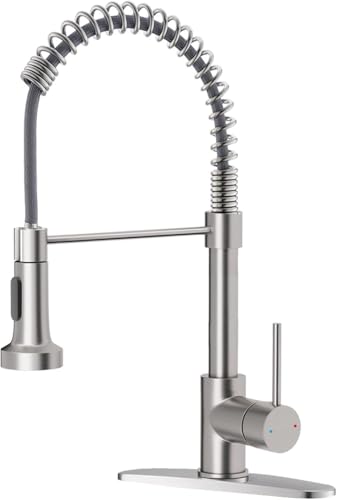
Dual-Function Spray Modes for Versatile Cleanup: Effortlessly toggle between Stream Mode (perfect for splash-free filling of deep stockpots and kettles) and High-Pressure Spray Mode (ideal for heavy-duty rinsing and blasting away stubborn food residue). The flexible commercial-style spring design allows for an extended range of motion, ensuring you can reach every corner of your sink to wash oversized baking sheets and pans with ease.

DURABLE MATERIAL: Kitchen faucet with spray head has been tested for 500,000 cycles for product stability, durability, and longevity. Kitchen faucets are made of 304 stainless steel for excellent corrosion and rust resistance.
Your Pre-Purchase Checklist to Avoid Missteps
Now that you’ve got your countertop measurements locked down, it’s time to get serious about what will actually fit. Skipping this checklist can lead to expensive returns and frustration.
Before you buy, I verify these essentials:
- Hole count and center-to-center spacing on my sink (1, 3, or 4 holes matter)
- Pre-drilled hole size requirements—usually 1 3/8 inches, but always confirm
- Whether my holes are center or side-positioned (side holes need longer spouts)
- Water line connections and shut-off valve sizes (typically 3/8 inch)
- If I’m upgrading to multi-hole, whether an escutcheon works for my setup
Manufacturers do not make universal faucets. You will not be shopping blindly once you nail these measurements. Ten minutes of checking can save you weeks of headaches.
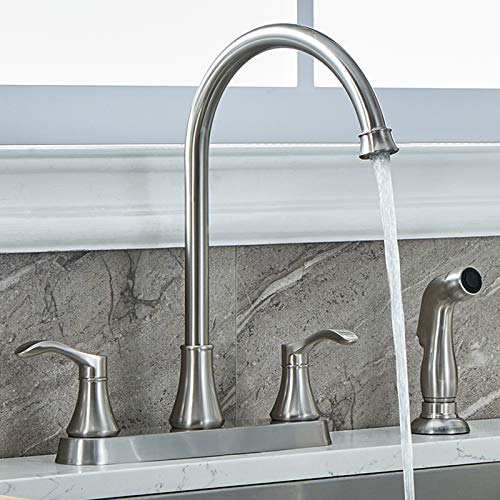
Lead-free Ceramic Cartridge & cUPC standard water hoses for healthy water. Brushed Nickel finish & Premium Solid Stainless Steel main body construction for durability.

Lead-Free SUS304 Stainless Steel Kitchen Faucet: Built with a SUS304 stainless steel spout and finished in matte black, this kitchen sink faucet resists rust, corrosion, and fingerprints. With a maximum water flow rate of 1.8 GPM, it provides steady water output for everyday kitchen cleaning while maintaining a clean, modern look

GUARANTEED QUALITY: Quality is our top priority, so all our kitchen sink faucets are tested and certified, meeting or exceeding industry codes and standards