
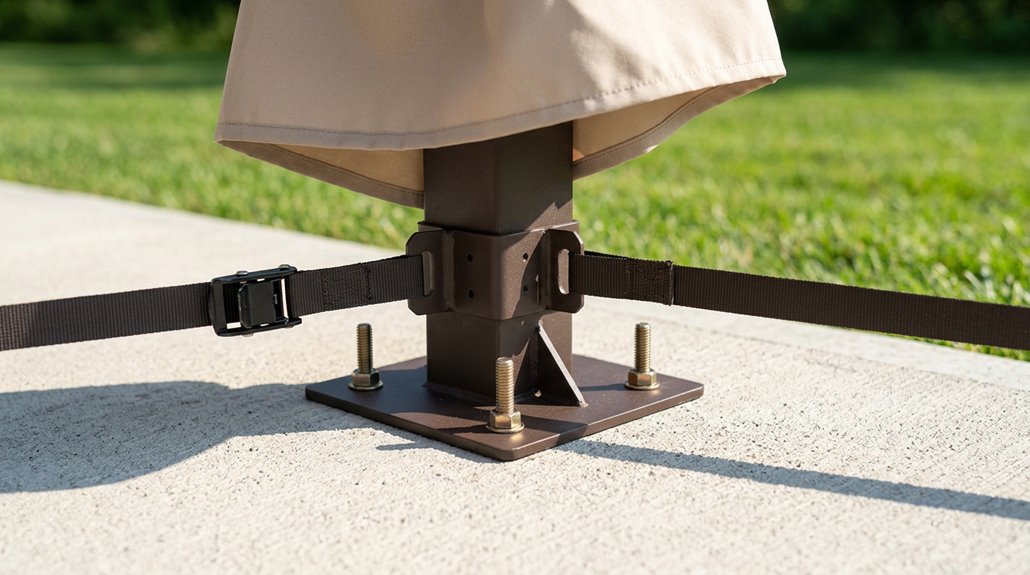
I’ve secured countless gazebos, and skipping concrete anchoring invites disaster.
First, inspect your slab for cracks and ensure it’s solid.
Mark holes at least 3–4 inches from the edges, using diagonal measurements for accuracy.
Drill with a carbide bit perpendicular to the surface.
Install wedge anchors flush, then torque bolts to specification.
Monthly tightening and storm checks ensure everything remains secure.
Get the specifics right, and you’ll be prepared for hurricane season.
Step 1: Check Your Gazebo Frame and Concrete Slab
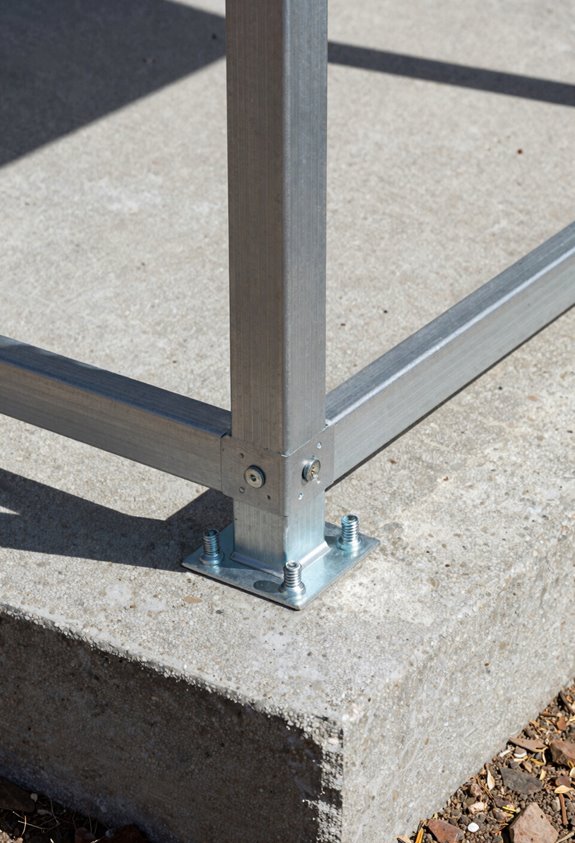
Why do so many people skip this step and regret it later? Rushing straight to drilling can lead to significant issues.
First, I inspect my gazebo frame carefully, checking that all base plates have proper anchor holes and that the legs sit level and square. This foundation is crucial. Next, I examine the concrete slab itself. I look for at least 4 inches of solid concrete, completely free of cracks or crumbling patches. Edge distance is critical; I keep my measurements well away from slab edges.
I also scout for hidden dangers like post-tensioning lines or radiant heating systems before considering drilling into concrete. This preliminary assessment determines whether I will use wedge anchors or alternative methods. This upfront work prevents costly mistakes and ensures a secure installation.

304 Stainless Steel Construction: Providing corrosion resistance for compatible concrete fastening applications in indoor and outdoor locations.

304 Stainless Steel Construction: Providing corrosion resistance for compatible concrete fastening applications in indoor and outdoor locations.
304 Stainless Steel Construction: Providing corrosion resistance for compatible concrete fastening applications in indoor and outdoor locations.
Step 2: Mark Anchor Holes on Your Concrete
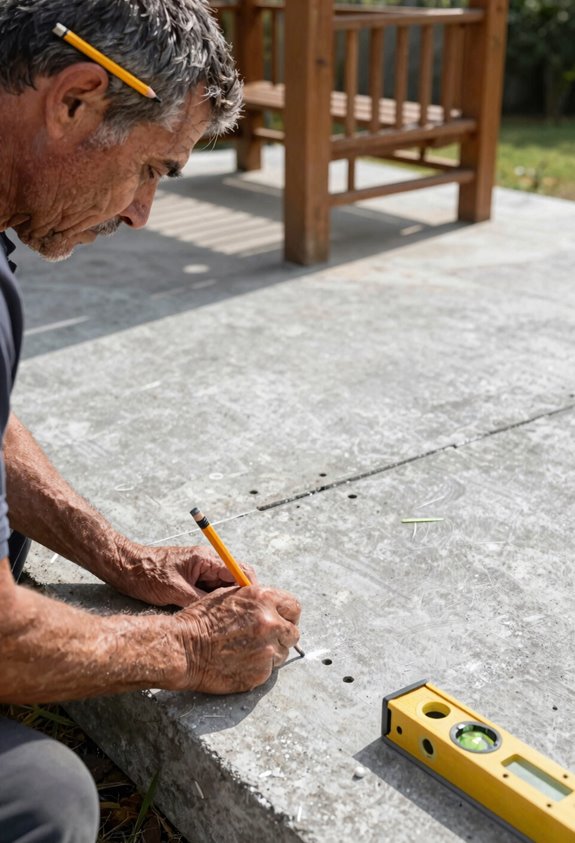
How you mark your anchor holes determines everything that comes after, and I learned this the hard way. I start by aligning my base plates precisely on the concrete, then trace through each mounting hole with a marker. I keep those hole marks at least 3–4 inches from the edge; this distance is important because it helps prevent cracking in the future. I always verify my layout is square using diagonals to confirm the concrete slab is true. Before I drill, I inspect for expansion joints and existing cracks; I never drill across them. I check that my concrete markings are clear and visible. Getting this step right ensures your masonry drill work goes smoothly, and your gazebo remains secure for years.
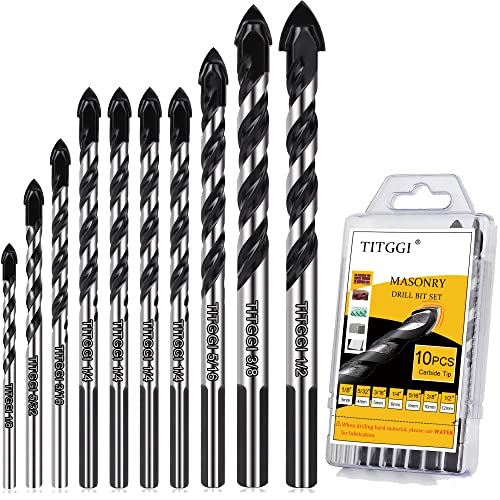
FOR HARD SURFACES: Wear-resistant tungsten carbide tip drills into brick, concrete, tile, glass, ceramic, travertine and hard plastic without slipping. Reinforced tip keeps its edge to deliver clean, steady holes for wall anchors, grab bars and shelves

CARBIDE TIPS AND STEEL BODIES: Each bit combines a spear-shaped carbide cutting tip with a steel body and spiral flutes that guide loosened material along the bit; use speed, pressure, and cooling suited to the surface

2 cutter carbide tip of masonry drill bit set maximizes carbide surface contact for longer bit life.
Step 3: Drill and Install Concrete Anchors
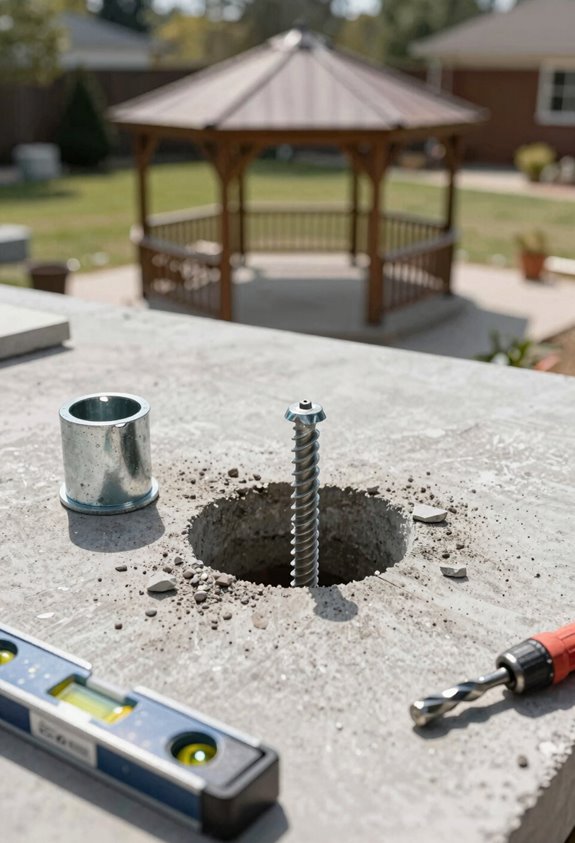
Once your hole marks are crisp and verified, grab your carbide masonry bit and start drilling those holes. This step is crucial for ensuring a stable gazebo during windstorms.
Drill each hole ¼ inch deeper than the length of your wedge anchors, keeping the masonry bit perpendicular to the slab. Then, insert the wedge anchors and tighten them flush with the concrete surface. Rushing this process can lead to significant issues.
Before finishing, verify that your base plates are level and flat. Also, check the slab thickness; a minimum of 4 inches is necessary to prevent the anchors from pulling through under load. This attention to detail distinguishes experienced installers from novices.

Solid Steel - The post bracket of this column is made of 2.0 mm thickness solid steel. Black premium powder coating. Absolutely rustproof.

Material Of 4x6 Post Base: Made of Solid Steel, Black Powder Coated, Rustproof and Strong.

This kit includes everything you need to make mounting your ceiling canopy to your junction box a much easier task
Step 4: Bolt Down Your Anchors Securely
This is where I’ve seen too many installers get sloppy, and I’ve made the same mistake myself. You’ve got your wedge anchors seated flush, so the next step is critical: bolting everything down with proper torque. Always check the manufacturer’s specifications; guessing is not an option. Hand-tighten your nuts first, then use a torque wrench to reach the exact specification. This ensures load distribution across your base plates and prevents plate twisting that could cause issues later. I’ve learned that under-tightened anchors loosen over time, while over-tightened ones can crack concrete. After torquing, verify that your base plate alignment remains square, as concrete anchors can shift slightly during tightening. It’s also important to inspect quarterly for corrosion resistance issues and any loosening. This step determines whether your gazebo remains stable or becomes unstable over time.

APPLICATION – 4 Inch diamond blade for angle grinder is designed for domestic and DIY use and intended for working on stone, marble, granite, brick, masonry and concrete. Our 4" diamond cutting wheel can be used for both dry and wet cutting.

【Smooth Transition Threshold】: Our aluminum floor transition is a perfect answer for finishing off a threshold between floors of different heights. It gives just enough incline over the threshold lip that the dolly cart/ wheelchair/ sweeping robot is able to make the transition smoothly and easily. Thus, you can easily get in and out of your house safely by yourself!

【Smooth Transition Threshold】: Our aluminum floor transition is a perfect answer for finishing off a threshold between floors of different heights. It gives just enough incline over the threshold lip that the dolly cart/ wheelchair/ sweeping robot is able to make the transition smoothly and easily. Thus, you can easily get in and out of your house safely by yourself!
Step 5: Keep Your Concrete Anchors Tight
Getting your anchors tightly secured in Step 4 is just the beginning. Concrete anchors require ongoing attention beyond their initial installation.
| Maintenance Task | Frequency |
|---|---|
| Tighten nuts | Monthly |
| Inspect corrosion | Biannually |
| Check plate flatness | After storms |
I check my anchors regularly because loose connections can compromise wind resistance and load transfer. I use torque specifications when available, as they provide essential guidelines. After storms, I recheck stability immediately. Inspecting for corrosion allows me to address rust before it weakens the grip. Biannual walkthroughs help catch issues early, ensuring holes are clean and properly seated.
Your gazebo’s security relies on this step. Make it a priority.

3/8" x 4" CONCRETE WEDGE ANCHORS: The package includes 10 complete wedge anchor assemblies, each measuring 3/8 inch in diameter and 4 inches in total length. Each concrete anchor comes with a preassembled nut and washer for convenient installation.

ICC-ES Approved: ESR-2251 certification for use in uncracked concrete. Meets building codes for structural applications and heavy-duty machinery

304 Stainless Steel Construction: Providing corrosion resistance for compatible concrete fastening applications in indoor and outdoor locations.